

Risk Management Frameworks help organizations manage uncertainty in a structured and proactive way. Instead of reacting to problems after they occur, businesses use these frameworks to identify threats, evaluate their impact, and create effective response plans. A strong framework supports better Risk Identification, improves Risk Assessment, and strengthens Governance across every department. It also encourages smarter decision-making, protects valuable assets, and helps organizations meet changing regulatory requirements.
Whether you run a small business or a global enterprise, implementing the right framework can improve resilience, reduce financial losses, and build customer trust. By promoting Continuous Improvement and stronger Risk Controls, organizations can confidently navigate challenges while achieving long-term growth and operational success.
“Organizations also use risk management frameworks to protect their digital assets and improve cybersecurity against evolving online threats.”
What Is a Risk Management Framework?
A Risk Management Framework is a structured approach that helps organizations identify, evaluate, control, monitor, and communicate risks throughout the business. Rather than handling problems only after they occur, the framework creates a repeatable process for Risk Identification, Risk Assessment, Risk Analysis, Risk Evaluation, and Risk Mitigation. It connects every department through shared policies and consistent decision-making, allowing leaders to respond confidently when uncertainty appears. The goal is not to eliminate every risk because that is impossible. Instead, the objective is to understand which risks matter most and manage them before they grow into serious business issues.
Every successful framework supports effective Governance, improves Decision Making, strengthens Compliance, and encourages Continuous Improvement. Organizations maintain a detailed Risk Register to document threats, assign Risk Ownership, evaluate potential impacts, and track progress. Business leaders also define their Risk Appetite and Risk Tolerance, ensuring every decision aligns with strategic objectives. As companies grow, a structured framework becomes an essential tool for protecting business value while maintaining operational stability.
Definition of a Risk Management Framework
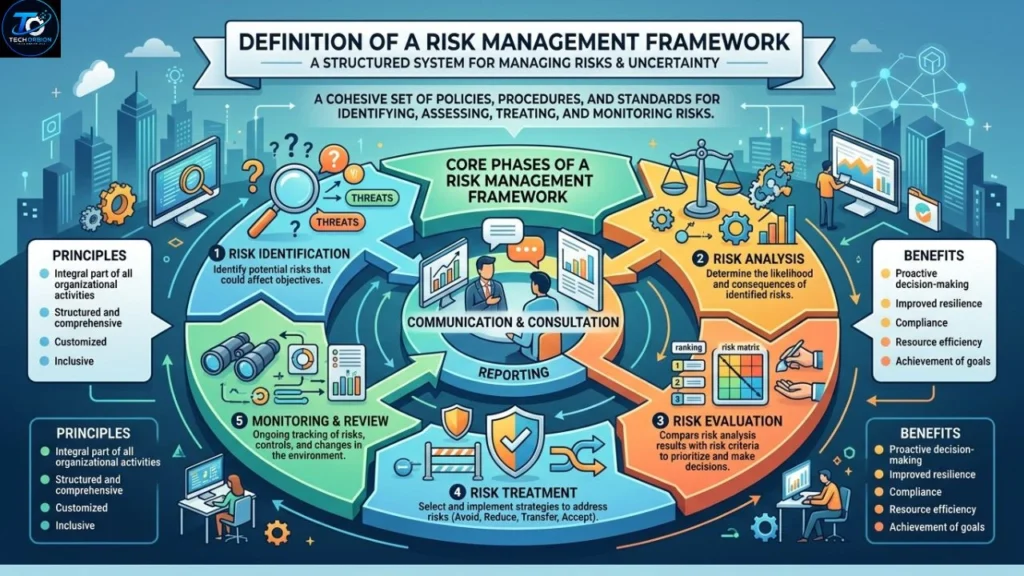
A Risk Management Framework combines policies, procedures, technologies, and business practices into one organized system for managing uncertainty. It provides guidance for identifying risks, selecting appropriate Risk Controls, performing regular Audit activities, and improving organizational performance over time. Instead of isolated actions, every decision becomes part of a coordinated process that strengthens resilience across the entire organization.
Core Purpose of Risk Management Frameworks
The primary purpose of Risk Management Frameworks is to help organizations reduce uncertainty while supporting business growth. Every framework enables leaders to prioritize resources, improve operational efficiency, and protect valuable assets. By following a structured process, organizations gain better visibility into potential threats before they affect revenue, customers, or long-term strategic goals.
How a Risk Management Framework Supports Business Goals
Business objectives become easier to achieve when risks are managed consistently. A strong framework aligns strategic planning with operational activities, allowing organizations to balance opportunity and uncertainty. As market conditions change, companies can adapt quickly without sacrificing stability, customer confidence, or future growth opportunities.
Why Are Risk Management Frameworks Important?
Modern organizations operate in an environment where technology, regulations, customer expectations, and global markets change almost every day. Without effective Risk Management Frameworks, even a small issue can develop into a major crisis. Cybersecurity incidents, regulatory violations, financial losses, operational failures, and supply chain interruptions often begin with risks that were either overlooked or underestimated. A structured framework helps organizations identify these threats early and create practical response plans before problems escalate.
Effective Risk Management Frameworks also strengthen Business Continuity, improve Disaster Recovery planning, support Incident Response, and enhance overall Organizational Resilience. Companies that regularly perform Risk Monitoring, Risk Reporting, and Risk Communication are better prepared to protect employees, customers, investors, and critical business assets. Instead of making decisions based on assumptions, leadership relies on accurate data and measurable risk insights.
Protecting Business Assets and Reputation
Every organization owns valuable assets that require protection. These include customer information, financial resources, intellectual property, technology infrastructure, and brand reputation. Strong Information Security practices combined with effective Security Controls help organizations defend these assets against evolving threats. When businesses manage risks proactively, customers and stakeholders develop greater confidence in the organization.
Improving Decision-Making and Governance
Business leaders make better choices when they understand both opportunities and risks. A structured framework provides reliable information that supports investments, expansion plans, technology adoption, and strategic initiatives. Better Governance creates accountability throughout the organization while encouraging every department to participate in responsible risk management.
Meeting Regulatory and Compliance Requirements
Governments and industry regulators continue introducing new security and privacy requirements. Organizations that follow recognized frameworks such as ISO 31000, NIST Risk Management Framework, NIST RMF, NIST Cybersecurity Framework, NIST CSF 2.0, COSO ERM, COBIT 2019, FAIR Framework, OCTAVE Framework, TARA Framework, ISO/IEC 42001, and the AI Risk Management Framework can demonstrate stronger Compliance while reducing legal exposure. These internationally recognized standards also simplify audits, improve documentation, and establish consistent risk management practices across the organization.
Why Every Organization Needs a Risk Management Framework
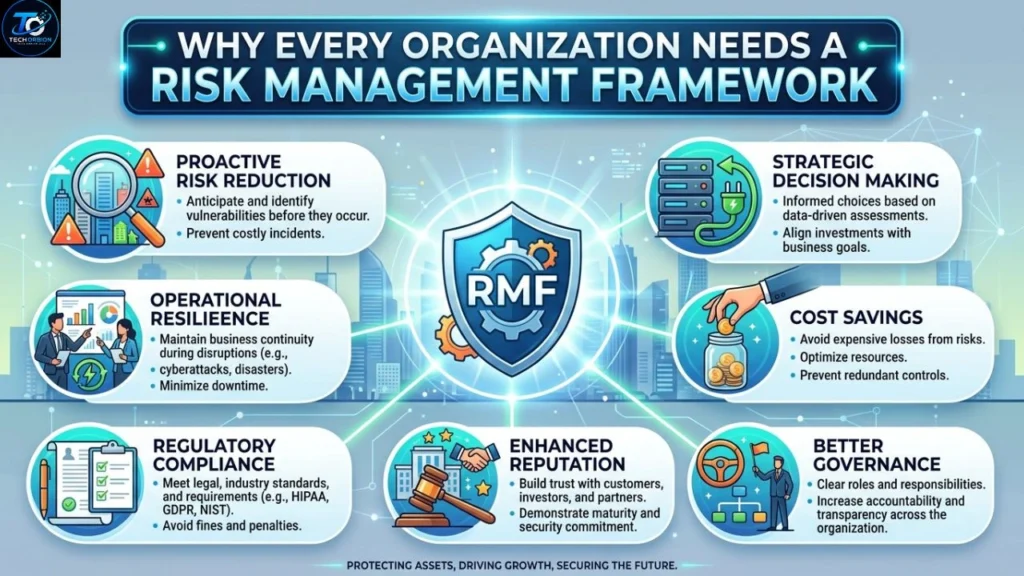
| Business Challenge | How a Risk Management Framework Helps |
| Cybersecurity threats | Improves threat detection and response |
| Financial uncertainty | Supports better financial planning |
| Regulatory changes | Simplifies compliance management |
| Operational failures | Reduces downtime and improves resilience |
| Vendor issues | Manages Third-Party Risk and Vendor Risk |
| Global disruptions | Strengthens Supply Chain Risk planning |
| Legal disputes | Reduces Legal Risk through proactive controls |
| Brand damage | Protects against Reputational Risk |
Risk Management Framework vs Risk Management Process
Many people use the terms Risk Management Framework and Risk Management Process as if they mean the same thing. However, they serve different purposes inside an organization. A Risk Management Framework is the complete structure that defines policies, responsibilities, governance, documentation, and long-term objectives for managing uncertainty. It creates consistency across every department and supports better Decision Making by establishing common standards. In contrast, the Risk Management Process focuses on the practical activities performed to identify, evaluate, and manage individual risks. Think of the framework as the blueprint and the process as the daily work that follows that blueprint.
Organizations achieve better results when both work together. A strong framework provides direction, while the process ensures that every risk moves through Risk Identification, Risk Assessment, Risk Analysis, Risk Evaluation, Risk Prioritization, Risk Treatment, and Risk Monitoring in a consistent manner. Without a framework, different teams may use different methods, creating confusion and increasing the chance of overlooking important threats.
Key Differences Explained
The biggest difference is scope. A Risk Management Framework establishes governance, accountability, documentation standards, and organizational objectives. The Risk Management Process describes the operational steps employees follow every day to evaluate and reduce risks. Together, they create a complete system that supports long-term business success.
When to Use Each Approach
Organizations should implement a framework before creating detailed processes. Once leadership defines policies, responsibilities, and business objectives, departments can build repeatable processes that follow the same standards. This approach improves efficiency and reduces inconsistency across teams.
Common Misconceptions
Many organizations believe completing a risk assessment means they already have a framework. In reality, assessments represent only one activity within a much larger system. A successful framework includes governance, continuous monitoring, reporting, communication, reviews, and ongoing improvement.
Risk Management Framework vs Risk Management Process
| Risk Management Framework | Risk Management Process |
| Long-term organizational structure | Daily operational activities |
| Defines policies and governance | Executes practical risk tasks |
| Establishes responsibilities | Identifies and manages risks |
| Supports strategic planning | Supports daily operations |
| Includes monitoring and improvement | Follows defined workflow |
Key Components of a Risk Management Framework
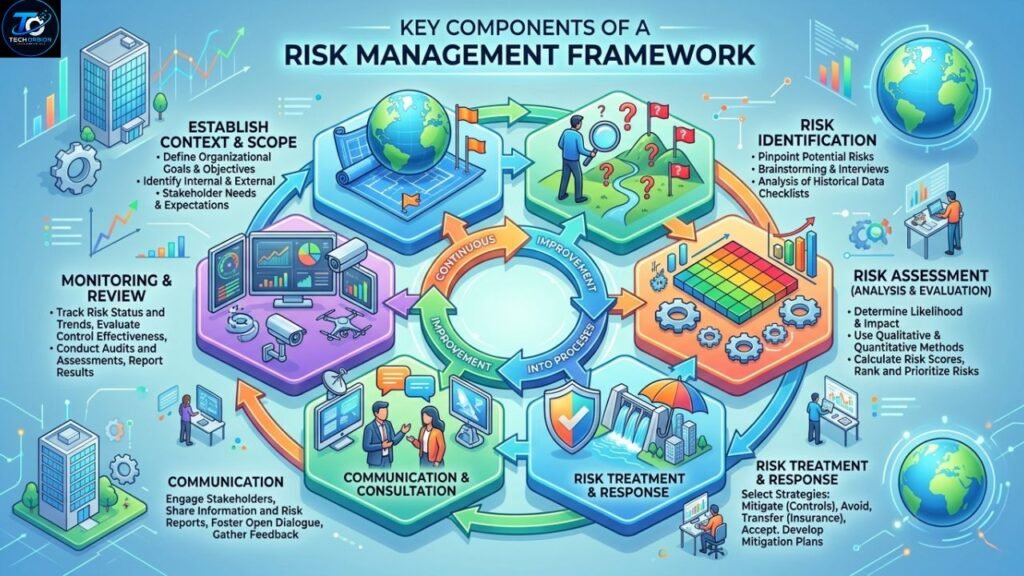
Every successful Risk Management Framework contains several connected components that work together to protect the organization. These components help businesses understand uncertainty, assign responsibilities, document threats, and improve responses over time. When one component is missing, the framework becomes weaker and may fail during unexpected situations. Strong organizations integrate these elements into everyday operations rather than treating risk management as a separate activity.
The framework also creates consistency across departments by ensuring everyone follows the same procedures. This improves Governance, strengthens Internal Controls, supports Compliance, and develops a positive Risk Culture throughout the organization. As new threats emerge, businesses can adapt more quickly because every component already supports Continuous Improvement.
Risk Governance
Effective Governance establishes leadership responsibilities and ensures executives actively participate in risk-related decisions. Senior management defines business objectives, approves policies, and monitors organizational performance while encouraging accountability across every department.
Policies and Procedures
Well-written policies explain how risks should be managed throughout the organization. Clear procedures help employees perform their responsibilities consistently while reducing confusion during daily operations and emergency situations.
Risk Assessment Methodology
Organizations need a consistent method for performing Risk Assessment and Risk Analysis. Standardized evaluation techniques improve accuracy and allow teams to compare risks using the same measurement criteria across multiple departments.
Controls and Mitigation Plans
Strong Risk Controls reduce the likelihood or impact of identified threats. These controls may include technical safeguards, administrative procedures, employee training, access restrictions, or security technologies that strengthen overall protection.
Continuous Monitoring and Reporting
Regular Risk Monitoring, Risk Reporting, and periodic Audit activities help organizations detect changes before problems become serious. Continuous reviews also improve future planning by identifying weaknesses and opportunities for improvement.
Core Components of a Risk Management Framework
| Component | Purpose |
| Governance | Provides leadership and accountability |
| Policies | Standardizes risk practices |
| Risk Assessment | Evaluates likelihood and impact |
| Risk Controls | Reduces business exposure |
| Monitoring | Tracks changing risks |
| Reporting | Supports informed decisions |
| Continuous Improvement | Enhances long-term effectiveness |
Types of Risks Organizations Face
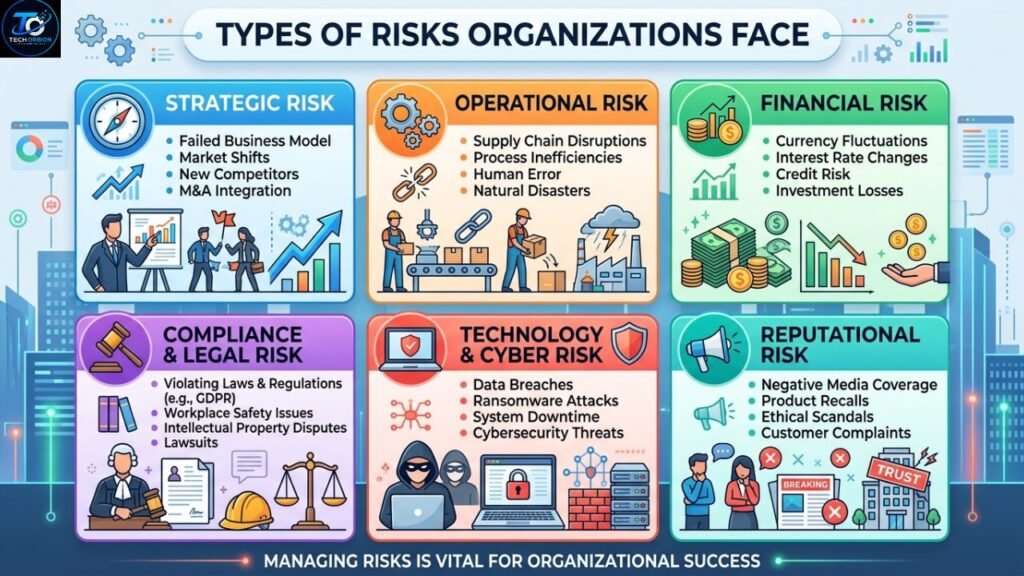
Every organization faces different forms of uncertainty depending on its industry, size, customers, and technology. Some risks develop gradually over several years, while others appear without warning. Understanding these categories allows organizations to prepare appropriate response strategies before damage occurs. Modern businesses rarely experience just one type of risk. Instead, multiple risks often interact, creating more complex situations that require careful planning.
A comprehensive Risk Management Framework helps organizations evaluate each category using structured methods while assigning appropriate Risk Ownership and response plans. This organized approach improves business resilience because leadership understands which risks require immediate attention and which can be monitored over time.
Strategic Risk
Strategic Risk affects long-term business goals. Poor investment decisions, market disruption, increased competition, or failed expansion strategies may reduce future growth and profitability.
Operational Risk
Operational Risk results from internal process failures, equipment breakdowns, employee mistakes, or inefficient workflows that interrupt normal business activities.
Financial Risk
Financial Risk includes cash flow problems, inflation, changing interest rates, investment losses, fraud, and unexpected economic downturns that affect profitability.
Compliance Risk
Organizations face Compliance Risk when they fail to follow industry regulations, government laws, or contractual obligations. Non-compliance may result in fines, lawsuits, and damaged credibility.
Cybersecurity Risk
Cybersecurity threats continue increasing every year. Data breaches, ransomware, phishing attacks, insider threats, and unauthorized system access threaten valuable business information and customer trust.
Reputational Risk
Negative publicity, poor customer service, ethical failures, or product quality issues can create serious Reputational Risk, reducing customer confidence and future revenue.
Environmental and Supply Chain Risk
Natural disasters, climate events, transportation disruptions, and supplier failures contribute to Supply Chain Risk, delaying production and affecting customer satisfaction.
Common Business Risks
| Risk Type | Example |
| Business Risk | Market competition |
| Operational Risk | Equipment failure |
| Financial Risk | Cash flow shortages |
| Compliance Risk | Regulatory violations |
| Legal Risk | Contract disputes |
| Third-Party Risk | Vendor security failure |
| Vendor Risk | Poor supplier performance |
| Supply Chain Risk | Shipping disruptions |
| Reputational Risk | Negative media coverage |
The Risk Management Lifecycle Explained
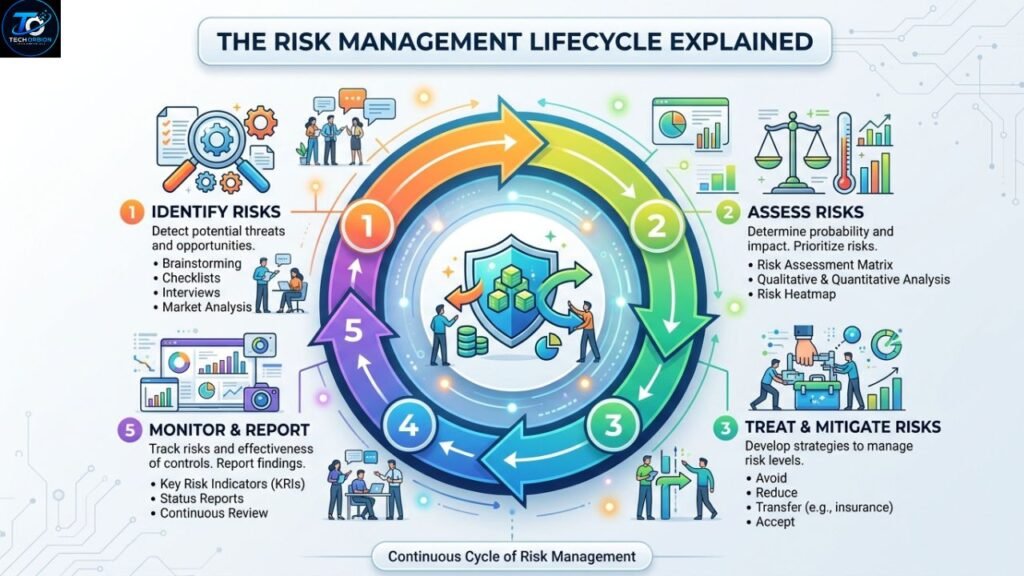
The Risk Management Lifecycle is a continuous cycle rather than a one-time project. Organizations constantly identify new threats, evaluate changing business conditions, implement improvements, and monitor results. As technology evolves and customer expectations shift, businesses must update their risk strategies to remain effective. Organizations that treat risk management as an ongoing process adapt faster and recover more successfully from unexpected events.
A mature lifecycle supports Business Continuity, strengthens Disaster Recovery, improves Incident Response, and increases Organizational Resilience. Instead of reacting during emergencies, organizations prepare in advance through structured planning, regular reviews, and continuous learning.
Planning
Planning establishes objectives, assigns responsibilities, and defines organizational priorities before formal risk activities begin.
Assessment
Teams perform Risk Assessment, analyze potential impacts, and determine which threats deserve immediate attention.
Response
Organizations implement Risk Treatment and Risk Mitigation strategies that reduce exposure while supporting business objectives.
Monitoring
Continuous Risk Monitoring detects new threats and measures whether existing controls remain effective over time.
Continuous Improvement
Organizations review lessons learned after every incident and strengthen future planning through Continuous Improvement, making the framework more effective each year.
Step 1: Risk Identification
Risk Identification is the foundation of every successful Risk Management Framework. Organizations cannot manage threats they have not recognized. This stage focuses on discovering events that could prevent business objectives from being achieved. Effective identification examines internal operations, external market conditions, technology, regulations, finances, suppliers, and human factors. The earlier a risk is discovered, the more options leaders have for reducing its impact.
Successful organizations encourage every employee to participate in Risk Identification because frontline staff often notice problems before management does. Workshops, interviews, brainstorming sessions, historical incident reviews, and data analysis all contribute valuable information. Once identified, each risk enters the Risk Register for future evaluation and management.
Identifying Internal Risks
Internal risks include employee errors, outdated technology, equipment failures, process weaknesses, poor communication, and inadequate Internal Controls that may affect daily operations.
Identifying External Risks
External risks originate outside the organization through changing regulations, economic conditions, cyber threats, competitors, political events, and environmental disasters.
Common Risk Identification Techniques
Organizations commonly use brainstorming, SWOT analysis, interviews, audits, historical reviews, surveys, process mapping, and expert consultations to discover potential risks before they become costly problems.
Step 2: Risk Assessment and Analysis
After completing Risk Identification, the next step is to determine how serious each risk is. Risk Assessment measures the likelihood that a risk will occur and estimates the impact it could have on business operations. This stage transforms assumptions into measurable information, allowing organizations to focus on the threats that deserve immediate attention. Without proper assessment, businesses may waste valuable time and resources on low-impact risks while ignoring critical vulnerabilities that threaten long-term success.
A structured Risk Assessment process also improves Decision Making because leaders rely on evidence instead of guesswork. During Risk Analysis, organizations collect historical data, evaluate current business conditions, and estimate financial, operational, legal, and reputational consequences. The results become the foundation for selecting effective Risk Controls and planning future Risk Treatment activities that align with business objectives.
Qualitative Risk Assessment
Qualitative assessment evaluates risks using descriptive ratings such as low, medium, or high. Experts consider experience, professional judgment, historical incidents, and business knowledge to estimate the probability and potential impact of each identified threat. This method works well when numerical data is limited or unavailable.
Quantitative Risk Assessment
Quantitative assessment uses measurable data, financial calculations, statistical models, and probability analysis to estimate potential losses. Organizations often apply this approach when evaluating investment risks, cybersecurity threats, or large infrastructure projects where financial accuracy is essential for executive decisions.
Risk Scoring Models
Risk scoring combines likelihood and impact into a numerical value that simplifies comparison between different threats. Many organizations use a Risk Matrix to visualize these scores and identify which risks require immediate action.
Example Risk Assessment Matrix
| Likelihood | Low Impact | Medium Impact | High Impact |
| Low | Low Risk | Low Risk | Medium Risk |
| Medium | Low Risk | Medium Risk | High Risk |
| High | Medium Risk | High Risk | Critical Risk |
Step 3: Risk Evaluation and Prioritization
Once risks have been analyzed, organizations must determine which ones require immediate attention. Risk Evaluation compares each identified threat against business objectives, available resources, and organizational priorities. Since every company operates with limited budgets and personnel, it isn’t practical to treat every risk equally. Instead, businesses focus first on the threats most likely to disrupt operations or cause significant financial losses.
Effective Risk Prioritization improves organizational efficiency by directing resources where they create the greatest value. Leadership considers business impact, regulatory obligations, customer expectations, and strategic importance before approving mitigation plans. This structured approach reduces uncertainty while supporting stronger Governance and long-term planning.
Risk Matrix
A Risk Matrix is one of the most popular evaluation tools. It compares likelihood against impact, allowing organizations to classify risks as low, moderate, high, or critical. This visual approach simplifies communication between technical teams and business executives.
Risk Appetite and Risk Tolerance
Every organization has a different Risk Appetite, which represents the amount of uncertainty leadership is willing to accept while pursuing business goals. Risk Tolerance defines the acceptable variation around those objectives before corrective action becomes necessary.
Prioritizing High-Impact Risks
High-priority risks receive immediate attention because they threaten critical assets, revenue, legal compliance, or customer trust. Lower-priority risks remain under observation and may receive treatment later as resources become available.
Example Risk Prioritization Table
| Risk | Likelihood | Business Impact | Priority |
| Ransomware Attack | High | Critical | Very High |
| Vendor Delay | Medium | Medium | Medium |
| Equipment Failure | Medium | High | High |
| Minor Website Error | Low | Low | Low |
Step 4: Risk Treatment and Mitigation
Identifying and evaluating risks has little value unless organizations take action. Risk Treatment focuses on selecting practical strategies that reduce the likelihood of risks occurring or minimize their consequences if they do occur. Every treatment plan should align with business goals, available resources, and regulatory requirements. Successful organizations regularly review these plans because business conditions and emerging threats continue to evolve.
An effective Risk Mitigation strategy strengthens Business Continuity, protects valuable assets, and increases customer confidence. Organizations combine technology, employee training, security policies, and operational improvements to reduce exposure. Strong Security Controls, proactive monitoring, and well-defined responsibilities create a safer business environment while supporting sustainable growth.
Risk Avoidance
Risk avoidance eliminates activities that create unacceptable exposure. Organizations may discontinue risky projects, avoid unstable markets, or replace outdated systems before they create serious problems.
Risk Reduction
Risk reduction lowers either the probability or the impact of a threat. Employee awareness programs, stronger authentication systems, software updates, and process improvements all contribute to reducing business exposure.
Risk Transfer
Organizations sometimes transfer risk to another party through insurance policies, outsourcing agreements, or contractual obligations. While responsibility may shift, organizations should continue monitoring these external relationships carefully.
Risk Acceptance
Some risks remain acceptable because their potential impact is minor or the cost of eliminating them exceeds the expected loss. Accepted risks should still be documented and monitored for future changes.
Common Risk Treatment Strategies
| Strategy | Purpose |
| Avoid | Eliminate the activity causing risk |
| Reduce | Lower likelihood or impact |
| Transfer | Shift responsibility through contracts or insurance |
| Accept | Monitor acceptable levels of risk |
Step 5: Risk Monitoring and Review
Risk management does not end after treatment plans are implemented. Businesses operate in constantly changing environments where new technologies, regulations, market conditions, and cyber threats create fresh challenges every day. Risk Monitoring ensures that organizations continuously evaluate existing controls while identifying emerging risks before they become major incidents. Without regular reviews, even the strongest framework can become outdated within a short period.
Continuous monitoring also supports Continuous Improvement by measuring whether current strategies remain effective. Organizations perform regular Audit activities, review performance indicators, update documentation, and revise mitigation plans whenever conditions change. This proactive approach strengthens Organizational Resilience while helping leadership make informed strategic decisions.
Continuous Monitoring
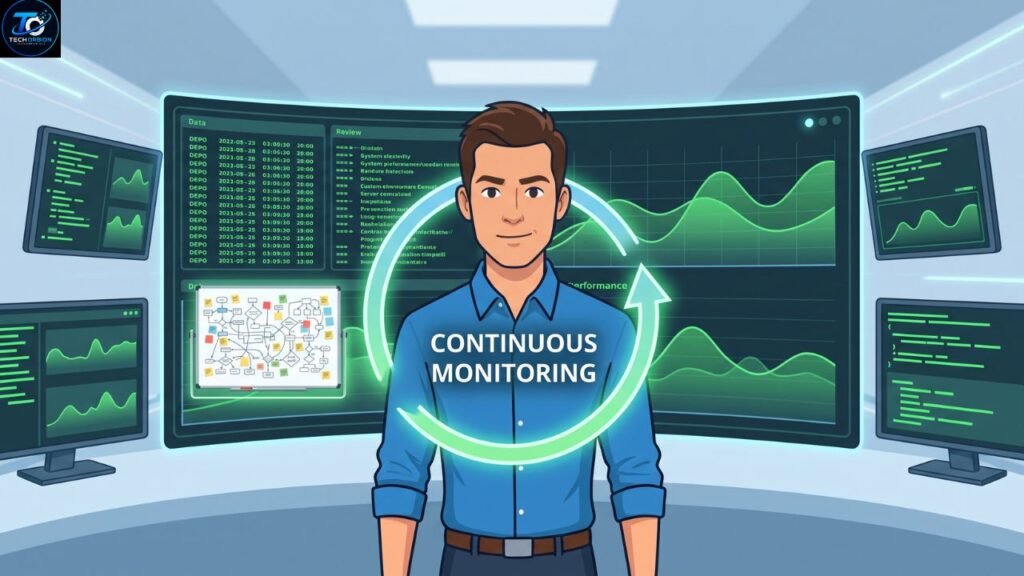
Continuous Risk Monitoring tracks business activities, cybersecurity events, operational performance, and compliance requirements in real time. Automated tools and dashboards often provide early warnings that help organizations respond quickly.
Key Risk Indicators (KRIs)
Key Risk Indicators measure changing risk conditions using predefined metrics. Rising cybersecurity incidents, increasing vendor delays, or declining customer satisfaction may signal growing business risks that require immediate attention.
Internal Audits and Reviews
Regular Audit activities verify whether policies, procedures, and Internal Controls operate effectively. Reviews also identify improvement opportunities that strengthen long-term organizational performance.
Step 6: Communication and Reporting
Successful Risk Management Frameworks depend on clear communication between leadership, employees, business partners, regulators, and stakeholders. Even the most detailed framework cannot protect an organization if critical information fails to reach the right people at the right time. Risk Communication ensures everyone understands current threats, assigned responsibilities, and required actions before incidents occur.
Effective Risk Reporting improves transparency and accountability throughout the organization. Regular reports summarize current risks, treatment progress, emerging threats, compliance status, and overall framework performance. Well-informed leadership can allocate resources more effectively while strengthening Governance and supporting faster business decisions.
Stakeholder Communication
Every stakeholder should receive information appropriate to their responsibilities. Executives need strategic summaries, while operational teams require detailed guidance for daily risk management activities.
Executive Reporting
Executive reports highlight critical risks, financial exposure, regulatory concerns, and mitigation progress. Clear reporting allows senior leadership to prioritize investments and strengthen organizational resilience.
Documentation Best Practices
Accurate documentation keeps the Risk Register current, records Risk Ownership, supports future audits, and demonstrates regulatory Compliance. Consistent documentation also improves collaboration across departments while preserving organizational knowledge.
Benefits of Effective Risk Communication
| Benefit | Business Value |
| Faster decisions | Better leadership response |
| Improved transparency | Greater stakeholder trust |
| Stronger compliance | Easier regulatory reporting |
| Better collaboration | Increased organizational efficiency |
| Accurate documentation | Improved future planning |
ISO 31000 Risk Management Framework
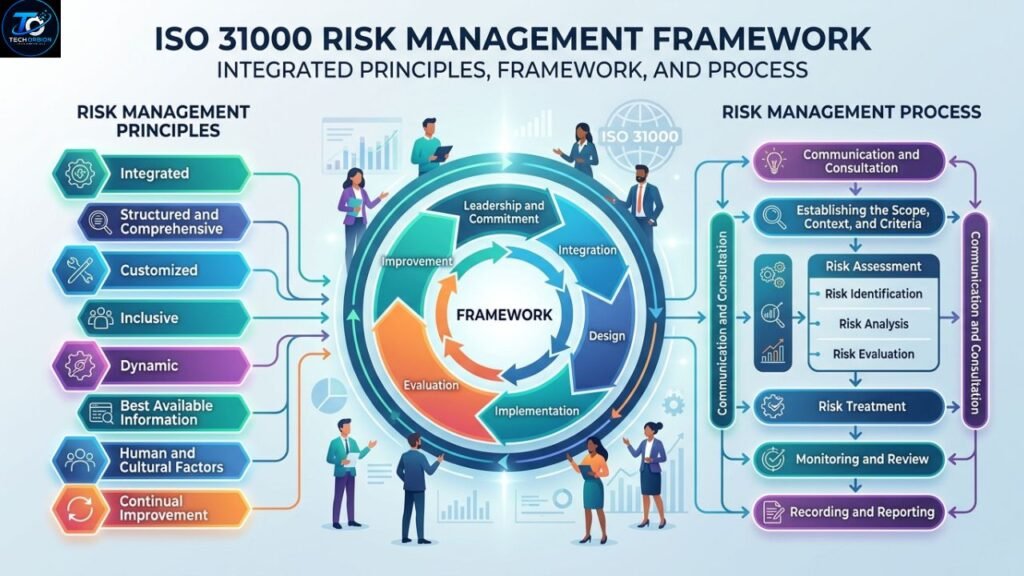
The ISO 31000 standard is one of the world’s most recognized approaches for building effective Risk Management Frameworks. Published by the International Organization for Standardization (ISO), it provides universal principles that organizations of every size and industry can apply. Unlike regulations that focus only on compliance, ISO 31000 encourages organizations to integrate risk management into daily operations, strategic planning, and executive decision-making. This flexible approach helps businesses improve resilience while supporting long-term growth.
One of the greatest strengths of ISO 31000 is its adaptability. Whether you manage a healthcare organization, financial institution, government agency, or technology company, the framework can be customized to meet your business objectives. Instead of treating risk management as a separate department, ISO 31000 embeds risk thinking into organizational culture, making it part of everyday business activities.
ISO 31000 Risk Management Guidelines — Risk management principles aur framework implementation ke liye official ISO guidance.
Overview of ISO 31000
ISO 31000 provides internationally accepted guidelines for identifying, evaluating, treating, monitoring, and communicating risks. Rather than prescribing strict rules, it offers practical principles that organizations can adapt according to their size, industry, and operational complexity.
Principles of ISO 31000
The framework emphasizes leadership commitment, continuous improvement, stakeholder involvement, structured processes, and informed Decision Making. Organizations following these principles create stronger Risk Culture, improve Governance, and develop more consistent business practices.
Benefits of ISO 31000
Businesses implementing ISO 31000 often experience improved Compliance, stronger organizational resilience, better resource allocation, and enhanced confidence among investors, customers, and regulators. The framework also supports better communication and more effective management of uncertainty.
Key Principles of ISO 31000
| Principle | Business Benefit |
| Integrated | Supports organization-wide risk management |
| Structured | Creates consistent processes |
| Customized | Fits different industries |
| Inclusive | Encourages stakeholder participation |
| Dynamic | Adapts to changing risks |
| Continuous Improvement | Strengthens long-term performance |
NIST Risk Management Framework (RMF)
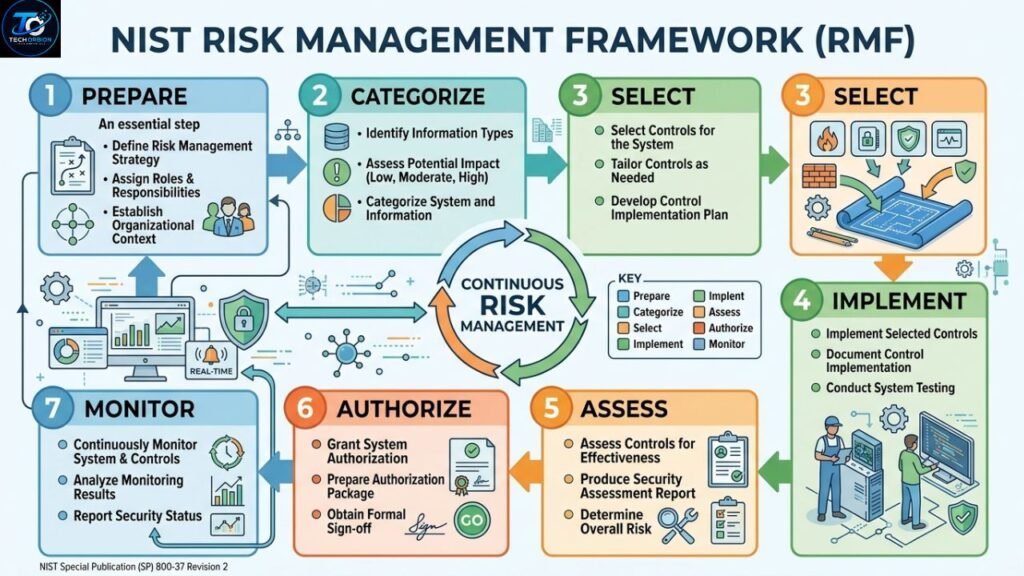
The NIST Risk Management Framework, commonly called NIST RMF, is one of the most respected cybersecurity frameworks worldwide. Developed by the National Institute of Standards and Technology, it helps organizations manage information security risks through a structured lifecycle. Although originally designed for U.S. federal agencies, private businesses, healthcare providers, educational institutions, and financial organizations now use NIST Risk Management Framework because of its practical and detailed approach.
Unlike general business frameworks, NIST RMF focuses heavily on protecting information systems. It combines Risk Assessment, Security Controls, continuous monitoring, and ongoing authorization into one repeatable process. Organizations using this framework strengthen cybersecurity while improving operational efficiency and regulatory compliance.
What Is NIST RMF?
The NIST RMF provides a structured process for managing cybersecurity risks throughout the entire system lifecycle. It helps organizations identify threats, implement appropriate controls, and continuously evaluate security effectiveness.
The Seven Steps of NIST RMF
The framework follows seven connected activities: Prepare, Categorize, Select, Implement, Assess, Authorize, and Monitor. Together these steps create a continuous security management cycle that improves long-term protection.
Who Should Use NIST RMF?
Government agencies, defense contractors, healthcare organizations, financial institutions, cloud service providers, and private enterprises all benefit from implementing the NIST Risk Management Framework because it improves cybersecurity maturity and supports regulatory compliance.
Seven Steps of NIST RMF
| Step | Purpose |
| Prepare | Establish organizational readiness |
| Categorize | Classify information systems |
| Select | Choose appropriate security controls |
| Implement | Apply selected controls |
| Assess | Verify control effectiveness |
| Authorize | Approve system operation |
| Monitor | Continuously evaluate security |
NIST Cybersecurity Framework (CSF)
The NIST Cybersecurity Framework, also known as NIST CSF 2.0, helps organizations improve cybersecurity regardless of their industry or size. Unlike NIST RMF, which focuses on system authorization and lifecycle management, NIST Cybersecurity Framework emphasizes continuous cybersecurity improvement across the entire organization. It provides flexible guidance that organizations can adopt without completely redesigning existing security programs.
Modern businesses face ransomware attacks, phishing campaigns, insider threats, and increasingly sophisticated cybercriminals. NIST CSF 2.0 provides a practical roadmap that helps organizations reduce cyber risks while improving resilience. Its flexible design allows businesses to strengthen cybersecurity gradually without disrupting normal operations.
Core Functions of NIST CSF
The framework organizes cybersecurity activities into six major functions: Govern, Identify, Protect, Detect, Respond, and Recover. Together they create a complete cybersecurity lifecycle that improves business resilience.
CSF 2.0 Updates
The newest version introduces stronger governance guidance, improved supply chain security recommendations, expanded leadership responsibilities, and greater flexibility for organizations outside government sectors.
Implementation Tips
Organizations should begin with a cybersecurity maturity assessment, identify current gaps, prioritize improvements, train employees regularly, and continuously monitor system performance to maximize the value of NIST CSF 2.0.
Core Functions of NIST CSF 2.0
| Function | Objective |
| Govern | Establish cybersecurity oversight |
| Identify | Understand organizational risks |
| Protect | Safeguard critical assets |
| Detect | Identify cybersecurity events |
| Respond | Contain security incidents |
| Recover | Restore business operations |
COSO Enterprise Risk Management Framework
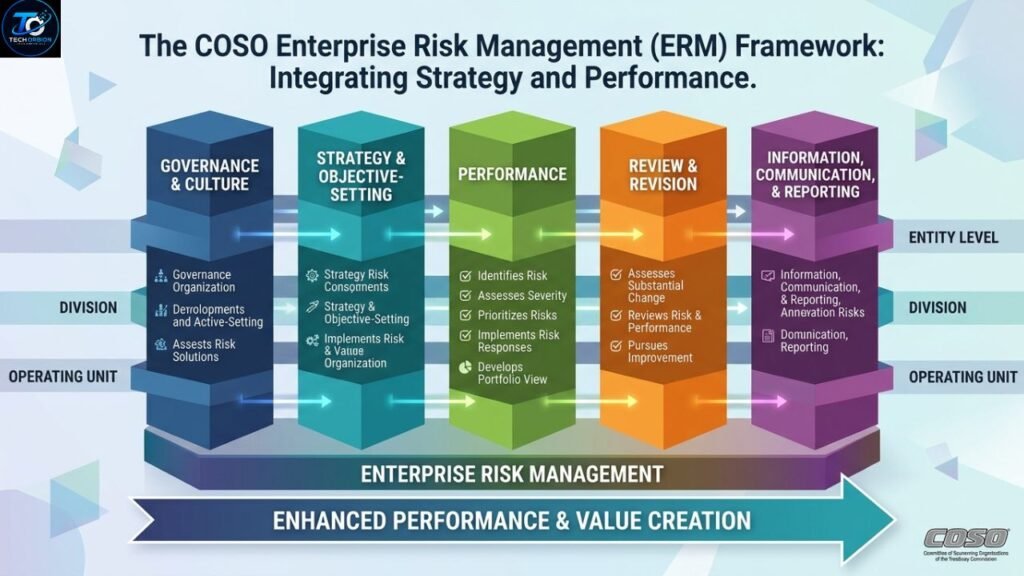
The COSO ERM framework extends traditional risk management beyond operational concerns by connecting risk directly to business strategy and organizational performance. Developed by the Committee of Sponsoring Organizations of the Treadway Commission, COSO ERM helps executives integrate risk into planning, governance, and performance measurement. This broader perspective enables organizations to make informed strategic decisions while balancing growth opportunities with potential risks.
Many multinational organizations adopt COSO ERM because it promotes accountability throughout the business. Rather than assigning risk management to a single department, the framework encourages leadership, managers, and employees to participate actively. This organization-wide approach strengthens governance while improving operational consistency.
COSO Principles
The framework focuses on governance, strategy, performance, review, and organizational culture. These principles ensure risk management becomes part of everyday business activities rather than a standalone initiative.
Governance and Strategy
Strong governance aligns risk management with organizational objectives. Leadership defines responsibilities, establishes accountability, and ensures risk considerations support strategic business planning.
Performance and Review
Regular performance reviews help organizations evaluate whether risk responses remain effective. Leadership can then adjust strategies as business conditions and emerging threats evolve.
COSO ERM Components
| Component | Purpose |
| Governance | Establish oversight |
| Strategy | Align risk with objectives |
| Performance | Evaluate business risks |
| Review | Measure effectiveness |
| Information | Improve communication |
FAIR Risk Management Framework
The FAIR Framework, short for Factor Analysis of Information Risk, introduces a different approach to cybersecurity risk management by emphasizing measurable financial analysis instead of subjective opinions. Rather than simply labeling risks as low, medium, or high, the FAIR Framework estimates potential financial losses, allowing executives to make business decisions using clear economic data.
Organizations increasingly adopt the FAIR Framework because executive leaders often understand financial metrics better than technical security reports. By translating cyber risks into monetary values, security teams communicate more effectively with business executives, investors, and board members.
Understanding FAIR
The FAIR Framework breaks cyber risk into measurable components, including threat frequency, vulnerability probability, and potential financial impact. This structured model improves communication between technical and business teams.
Quantifying Cyber Risk
Instead of relying solely on expert judgment, the framework calculates expected financial losses using statistical analysis, historical data, and probability models. This creates more objective investment decisions.
FAIR Use Cases
Large enterprises, financial institutions, cybersecurity teams, insurance companies, and organizations managing critical infrastructure frequently use the FAIR Framework to prioritize security investments and demonstrate return on investment.
FAIR Framework Benefits
| Benefit | Value |
| Financial Analysis | Measures business impact |
| Better Communication | Supports executive decisions |
| Objective Evaluation | Reduces subjective estimates |
| Investment Planning | Prioritizes cybersecurity spending |
| Strategic Decisions | Aligns security with business goals |
COBIT 2019 Framework
The COBIT 2019 framework is a globally recognized model for IT governance and management. Developed by ISACA, it helps organizations align technology with business goals while improving Governance, Compliance, and overall performance. Unlike frameworks that focus only on cybersecurity or operational risk, COBIT 2019 provides a complete governance system that ensures information technology supports business success. Organizations use it to balance innovation, regulatory requirements, and risk management without sacrificing efficiency.
Modern businesses depend heavily on digital systems, cloud platforms, and connected technologies. As technology becomes more complex, organizations need stronger oversight to manage risks effectively. COBIT 2019 improves Decision Making, strengthens Internal Controls, and supports better collaboration between executives, IT teams, and business leaders. The framework also complements standards such as ISO 31000, NIST RMF, and COSO ERM, making it an excellent choice for organizations seeking an integrated governance strategy.
COBIT Governance Model
The governance model separates governance activities from management responsibilities. Governance focuses on evaluating business objectives, directing organizational priorities, and monitoring performance, while management plans, builds, operates, and continuously improves IT services.
Business Alignment
One of the greatest strengths of COBIT 2019 is its ability to align technology investments with business objectives. Organizations reduce unnecessary spending while ensuring every technology initiative contributes measurable value and supports long-term strategic growth.
Risk and Compliance Integration
The framework integrates Compliance, Audit, Risk Controls, and performance measurement into one consistent governance model. This integration helps organizations reduce operational uncertainty while meeting legal and regulatory requirements more efficiently.
COBIT 2019 Governance Objectives
| Governance Area | Business Benefit |
| Strategic Alignment | Supports business objectives |
| Risk Management | Reduces technology risks |
| Compliance | Meets regulatory requirements |
| Performance Monitoring | Improves operational efficiency |
| Resource Optimization | Maximizes technology investments |
OCTAVE Risk Assessment Framework
The OCTAVE Framework, which stands for Operationally Critical Threat, Asset, and Vulnerability Evaluation, helps organizations identify and evaluate cybersecurity risks from a business perspective. Unlike frameworks that rely mainly on technical security testing, the OCTAVE Framework encourages organizations to understand how operational processes, critical assets, and people contribute to overall risk exposure. This broader perspective creates stronger security strategies that reflect real business priorities.
Organizations adopting the OCTAVE Framework focus first on protecting their most valuable assets before selecting technical solutions. Instead of reacting to individual cyber threats, leadership evaluates business operations, identifies vulnerabilities, and develops long-term security improvements. This structured approach strengthens Information Security, supports Business Continuity, and improves organizational resilience.
OCTAVE Overview
The OCTAVE Framework provides a self-directed methodology that helps organizations identify critical assets, evaluate operational risks, and prioritize security improvements according to business objectives rather than technology alone.
OCTAVE Process
Organizations begin by identifying essential business assets, analyzing existing vulnerabilities, evaluating possible threats, and developing practical protection strategies. This process ensures resources focus on the areas with the greatest business value.
Benefits and Limitations
The framework encourages strong collaboration between technical experts and business leaders. However, because it requires detailed organizational participation, implementation may take longer than simpler risk assessment methods.
OCTAVE Framework Process
| Phase | Purpose |
| Asset Identification | Identify critical business assets |
| Threat Analysis | Understand possible threats |
| Vulnerability Assessment | Discover organizational weaknesses |
| Risk Evaluation | Prioritize security improvements |
TARA (Threat Assessment and Remediation Analysis)
The TARA Framework is designed to help organizations identify, evaluate, and prioritize cyber threats before selecting appropriate security controls. Instead of applying every available security measure, TARA Framework focuses on protecting systems against the threats most likely to affect the organization. This practical approach improves efficiency by reducing unnecessary spending while increasing protection against real-world attacks.
As cyber threats become more sophisticated, organizations must invest resources wisely. The TARA Framework helps security teams evaluate attack scenarios, understand business impact, and implement targeted remediation strategies. By concentrating on realistic threats, businesses improve Incident Response, strengthen Security Controls, and reduce overall cybersecurity risk.
What Is TARA?
The TARA Framework provides a structured methodology for assessing threats, identifying vulnerable assets, and recommending security improvements that align with business priorities and available resources.
Threat Prioritization
Organizations rank threats according to likelihood, potential impact, business value, and existing safeguards. This process ensures limited resources focus on the most critical cybersecurity challenges first.
Industry Applications
Financial institutions, healthcare providers, government agencies, manufacturing companies, and technology organizations frequently apply the TARA Framework to improve cybersecurity planning and operational resilience.
TARA Framework Advantages
| Advantage | Business Value |
| Threat Prioritization | Focuses on critical risks |
| Better Resource Allocation | Reduces unnecessary spending |
| Stronger Security | Improves cyber defense |
| Faster Response | Enhances incident management |
ISO/IEC 42001 AI Risk Management Framework
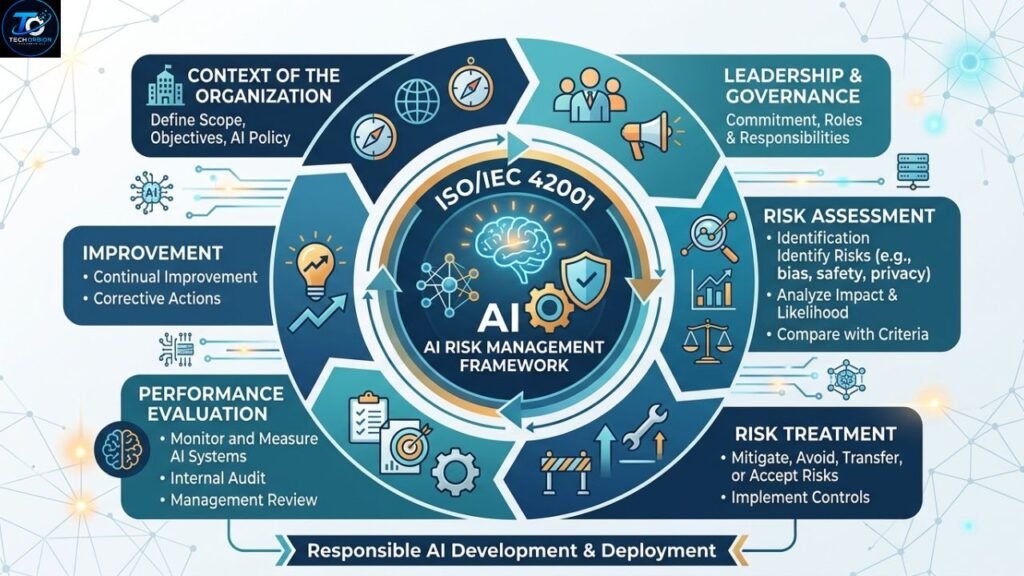
Artificial intelligence is transforming modern business, but it also introduces new ethical, legal, and operational challenges. The ISO/IEC 42001 standard provides the first internationally recognized management system for responsible AI governance. Organizations developing or deploying artificial intelligence use this framework to manage AI-related risks while maintaining transparency, accountability, and regulatory compliance. As AI adoption grows across industries, structured governance becomes essential for protecting customers and maintaining public trust.
The AI Risk Management Framework helps organizations evaluate AI systems throughout their lifecycle. It encourages responsible development, continuous monitoring, human oversight, and ongoing improvement. Businesses that follow ISO/IEC 42001 demonstrate their commitment to trustworthy AI while reducing legal exposure and strengthening organizational credibility.
AI Governance Basics
Effective AI governance establishes clear responsibilities, ethical guidelines, performance monitoring, and oversight mechanisms. Organizations ensure AI systems operate fairly, transparently, securely, and consistently with business objectives.
Managing AI Risks
AI introduces risks such as algorithmic bias, privacy concerns, inaccurate predictions, data security issues, and regulatory uncertainty. The AI Risk Management Framework helps organizations identify and reduce these risks before they affect business operations.
Compliance and Ethical AI
Organizations implementing ISO/IEC 42001 strengthen Compliance, improve stakeholder confidence, and demonstrate responsible AI practices that align with emerging international regulations and ethical standards.
AI Risk Categories
| AI Risk | Example |
| Bias | Unfair automated decisions |
| Privacy | Personal data misuse |
| Security | AI model attacks |
| Compliance | Regulatory violations |
| Transparency | Limited explainability |
How to Choose the Right Risk Management Framework

Selecting the right framework depends on your organization’s size, industry, business objectives, regulatory obligations, and available resources. There is no universal solution because every organization faces different challenges. A financial institution may prioritize NIST Cybersecurity Framework, while a multinational corporation may benefit from COSO ERM or ISO 31000. Technology-driven organizations often combine multiple frameworks to create a comprehensive risk management strategy that addresses operational, cybersecurity, and governance requirements simultaneously.
Before selecting a framework, organizations should evaluate their current maturity, identify existing weaknesses, and understand future business goals. Leadership should also consider implementation costs, employee expertise, technology requirements, and long-term scalability. The best framework is one that supports business growth while strengthening Risk Culture, improving Organizational Resilience, and encouraging Continuous Improvement.
Business Size Considerations
Small businesses often prefer flexible frameworks that are easier to implement, while large enterprises typically require comprehensive governance models capable of managing complex organizational structures and regulatory obligations.
Industry Requirements
Highly regulated industries such as healthcare, banking, energy, and government frequently adopt frameworks with strong compliance guidance, while technology companies often prioritize cybersecurity and information protection.
Budget and Resources
Implementation should match available financial and human resources. Organizations should choose frameworks they can maintain effectively over the long term rather than selecting overly complex solutions.
Compliance Needs
Businesses operating under multiple regulations should prioritize frameworks that simplify audits, documentation, and legal compliance while supporting international standards and industry best practices.
Comparing Popular Risk Management Frameworks
| Framework | Best For | Primary Focus |
| ISO 31000 | All industries | Enterprise risk management |
| NIST Risk Management Framework | Government & regulated sectors | Information security |
| NIST CSF 2.0 | Organizations of all sizes | Cybersecurity improvement |
| COSO ERM | Large enterprises | Strategy and governance |
| FAIR Framework | Financial risk analysis | Quantifying cyber risk |
| COBIT 2019 | IT organizations | IT governance |
| OCTAVE Framework | Security planning | Asset-based risk assessment |
| TARA Framework | Cybersecurity teams | Threat prioritization |
| ISO/IEC 42001 | AI-driven organizations | AI governance |
How to Implement a Risk Management Framework
Implementing Risk Management Frameworks requires more than choosing a popular standard. Organizations must build a structured system that aligns with business goals, supports daily operations, and encourages every employee to participate in managing risk. A successful implementation begins with leadership commitment because executives establish priorities, allocate resources, and create a culture where risk awareness becomes part of everyday decision-making. Without strong leadership, even the most advanced framework will struggle to produce meaningful results.
Implementation should happen gradually rather than all at once. Organizations should first understand their current risk maturity, identify gaps, define responsibilities, and develop practical policies. After that, teams can perform Risk Identification, conduct Risk Assessment, implement Risk Controls, and monitor progress continuously. Regular reviews ensure the framework evolves alongside changing business conditions, new technologies, and emerging threats.
Build a Risk Management Team
Every successful framework begins with a dedicated team that represents different departments across the organization. Senior leadership, IT professionals, finance specialists, compliance officers, legal advisors, and operational managers should work together to ensure risks are identified from multiple perspectives. This collaborative approach strengthens Risk Ownership and improves communication throughout the organization.
Develop Policies
Clear policies establish consistent expectations for employees and management. These policies define responsibilities, reporting procedures, approval processes, documentation standards, and acceptable Risk Appetite. Well-written policies also improve Governance by ensuring every department follows the same risk management practices.
Conduct Risk Assessments
Organizations should perform detailed Risk Assessment activities regularly rather than waiting for major incidents. Every assessment should evaluate existing threats, identify new vulnerabilities, measure potential impacts, and determine whether current controls remain effective. This process supports informed business decisions while reducing uncertainty.
Deploy Controls
Once risks have been evaluated, organizations implement technical, administrative, and operational controls that reduce exposure. Strong Security Controls, employee awareness training, access management, encryption, and system monitoring all contribute to a stronger security posture.
Measure Performance
Implementation does not end after deploying controls. Organizations should establish measurable performance indicators, review progress through regular Audit activities, and update the framework whenever business objectives or risk conditions change. Continuous evaluation ensures long-term effectiveness.
Risk Management Framework Implementation Roadmap
| Implementation Stage | Primary Objective |
| Leadership Commitment | Build organizational support |
| Policy Development | Create consistent standards |
| Risk Assessment | Identify and evaluate risks |
| Control Implementation | Reduce organizational exposure |
| Monitoring | Measure effectiveness |
| Continuous Improvement | Strengthen long-term resilience |
Common Challenges in Risk Management Implementation
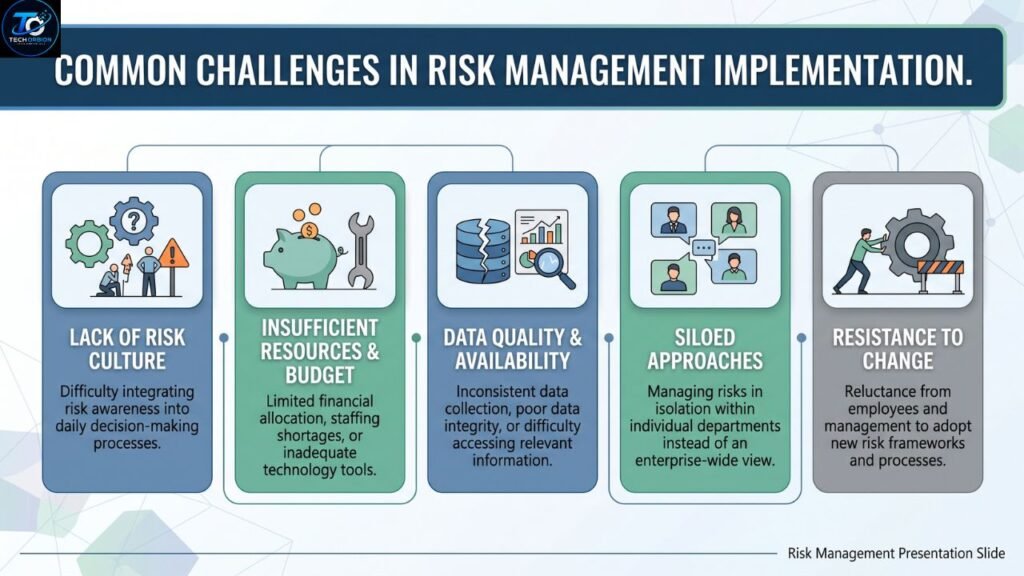
Although many organizations recognize the importance of Risk Management Frameworks, successful implementation is rarely straightforward. Businesses often encounter technical limitations, budget constraints, employee resistance, and changing regulatory requirements. These challenges can slow progress and reduce the overall effectiveness of the framework if they are not addressed proactively. Understanding these obstacles helps organizations prepare realistic implementation strategies while avoiding common mistakes.
Successful organizations treat implementation as an ongoing improvement program rather than a one-time project. They regularly review business processes, encourage employee participation, invest in modern technology, and strengthen communication between departments. This proactive approach builds greater Organizational Resilience while reducing operational uncertainty.
Limited Resources
Many organizations operate with limited budgets, staffing, and technical expertise. These limitations may delay implementation or reduce the effectiveness of risk management activities. Prioritizing high-impact risks first allows organizations to maximize available resources.
Employee Resistance
Employees sometimes view new policies as unnecessary additional work. Organizations should provide practical training, explain business benefits, and encourage participation to create a positive Risk Culture where everyone understands their responsibilities.
Lack of Executive Support
Without executive sponsorship, risk management initiatives often lose momentum. Senior leadership should actively participate by allocating resources, reviewing performance, and demonstrating commitment to organizational risk management.
Rapidly Changing Threats
Technology evolves rapidly, creating new cyber threats, regulatory requirements, and operational challenges. Organizations must review their frameworks regularly to remain effective against emerging risks.
Common Implementation Challenges
| Challenge | Practical Solution |
| Limited Budget | Prioritize critical risks |
| Employee Resistance | Provide continuous training |
| Weak Leadership Support | Increase executive involvement |
| Complex Regulations | Improve compliance planning |
| Emerging Cyber Threats | Strengthen continuous monitoring |
Best Practices for Effective Risk Management
Organizations that achieve long-term success do more than follow a framework. They develop consistent habits that strengthen decision-making, improve communication, and encourage continuous learning. Effective Risk Management Frameworks become part of everyday business operations rather than existing only as written documentation. When employees understand how their daily responsibilities contribute to organizational success, risk management becomes a shared responsibility instead of a separate function.
Best-performing organizations also invest in employee education, modern technology, and regular performance reviews. They maintain updated documentation, encourage transparent reporting, and continuously evaluate changing business conditions. These practices improve Business Continuity, strengthen Compliance, and create a resilient organization capable of responding to unexpected challenges.
Build a Risk-Aware Culture
Every employee should understand that managing risk is part of their daily responsibilities. Open communication, leadership support, and continuous education help create a workplace where employees identify and report risks without hesitation.
Review Risks Regularly
Business conditions change constantly. Organizations should perform regular reviews, update the Risk Register, evaluate new threats, and revise mitigation strategies to maintain effective protection.
Use Automation and AI
Modern organizations increasingly rely on automation to improve Risk Monitoring, analyze large volumes of data, and detect unusual activity before it develops into serious incidents. Automation also improves reporting accuracy and operational efficiency.
Train Employees Continuously
Well-trained employees recognize potential threats earlier and respond more effectively during incidents. Regular training sessions, cybersecurity awareness programs, and simulated exercises strengthen organizational preparedness while reducing human error.
Best Practices Summary
| Best Practice | Business Benefit |
| Strong Leadership | Better governance |
| Regular Risk Reviews | Improved preparedness |
| Employee Training | Reduced human error |
| Automation | Faster detection |
| Continuous Improvement | Long-term resilience |
How AI Is Transforming Risk Management
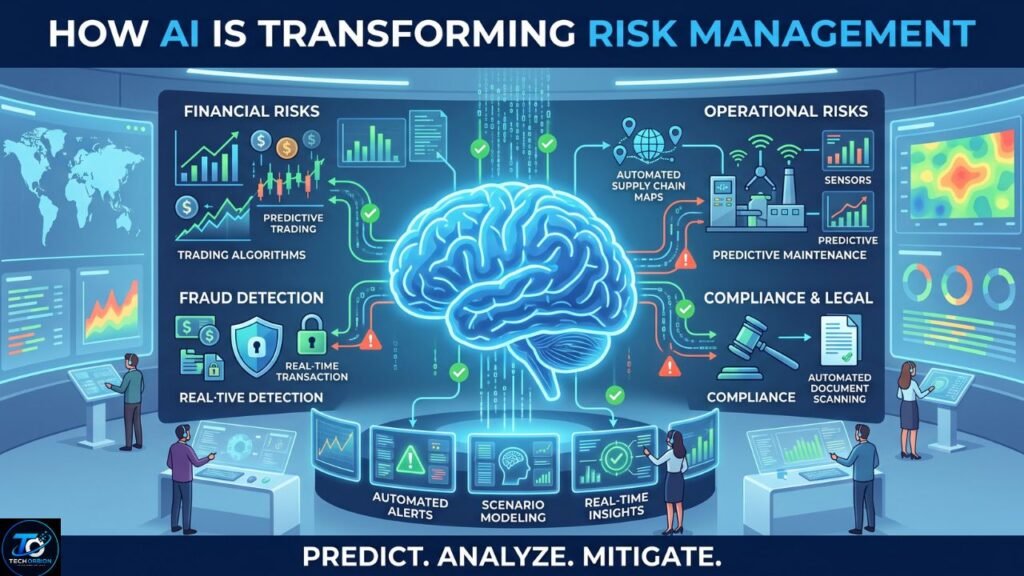
Artificial intelligence is changing the way organizations identify, evaluate, and respond to risks. Traditional risk management often depended on manual reviews and historical information, making it difficult to detect rapidly changing threats. Today, AI-powered technologies analyze enormous amounts of data within seconds, helping organizations discover patterns that human analysts might overlook. This capability allows businesses to predict risks earlier, respond faster, and make better strategic decisions.
Modern AI solutions support the AI Risk Management Framework by improving threat detection, fraud prevention, regulatory compliance, and operational efficiency. Machine learning continuously improves as new information becomes available, enabling organizations to strengthen cybersecurity, reduce financial losses, and increase overall resilience. However, organizations should also monitor AI systems carefully to ensure transparency, fairness, and regulatory compliance.
Predictive Analytics
Predictive analytics uses historical information and machine learning models to forecast future risks before they affect business operations. Organizations can prepare mitigation strategies earlier and reduce unexpected disruptions.
Automated Risk Detection
Artificial intelligence continuously monitors business systems for unusual behavior, suspicious transactions, cybersecurity attacks, and operational anomalies. Early detection allows security teams to respond quickly before incidents escalate.
AI-Powered Compliance Monitoring
AI helps organizations monitor changing regulations, identify compliance gaps, automate documentation, and simplify reporting activities. This reduces manual effort while improving regulatory accuracy.
Future Trends
Future risk management will combine artificial intelligence, real-time analytics, cloud computing, automation, and predictive modeling to create more intelligent and adaptive frameworks. Organizations embracing these innovations will gain stronger resilience and better competitive advantages.
Traditional Risk Management vs AI-Powered Risk Management
| Traditional Approach | AI-Powered Approach |
| Manual analysis | Automated analysis |
| Historical reporting | Real-time monitoring |
| Reactive decisions | Predictive insights |
| Periodic reviews | Continuous monitoring |
| Limited scalability | Large-scale data analysis |
Benefits of Using Risk Management Frameworks
Organizations that implement Risk Management Frameworks gain far more than protection against unexpected events. A well-designed framework improves business performance by helping leaders make informed decisions, allocate resources wisely, and prepare for future challenges. Instead of reacting to problems after they occur, organizations identify threats early and develop practical solutions that reduce disruption. This proactive approach strengthens operational stability while supporting long-term business growth.
The benefits extend beyond financial savings. Effective Risk Management Frameworks build stronger customer confidence, improve regulatory compliance, protect valuable assets, and create a culture where every employee contributes to organizational success. Businesses that continuously improve their frameworks are better prepared to respond to changing markets, evolving cyber threats, and increasing regulatory expectations.
Better Decision-Making
Reliable risk information enables executives to make informed strategic decisions based on evidence rather than assumptions. Accurate Risk Analysis improves planning, budgeting, investment decisions, and business expansion while reducing uncertainty.
Stronger Cybersecurity
Organizations using structured frameworks strengthen Information Security, improve Incident Response, and implement effective Security Controls that reduce exposure to cyberattacks and data breaches.
Regulatory Compliance
Well-documented frameworks simplify Compliance, support regulatory reporting, and make internal and external Audit activities more efficient. This reduces legal exposure while improving organizational credibility.
Improved Business Resilience
Strong frameworks support Business Continuity, strengthen Disaster Recovery, and increase Organizational Resilience by preparing organizations for unexpected disruptions before they occur.
Increased Stakeholder Confidence
Customers, investors, regulators, and business partners trust organizations that demonstrate mature risk management practices. This confidence strengthens reputation, improves investment opportunities, and supports sustainable business growth.
Benefits of Risk Management Frameworks
| Benefit | Business Impact |
| Better Decision Making | Smarter strategic planning |
| Stronger Cybersecurity | Reduced security incidents |
| Improved Compliance | Easier regulatory management |
| Business Continuity | Faster operational recovery |
| Customer Trust | Improved brand reputation |
| Organizational Resilience | Better long-term stability |
Real-World Examples of Risk Management Frameworks
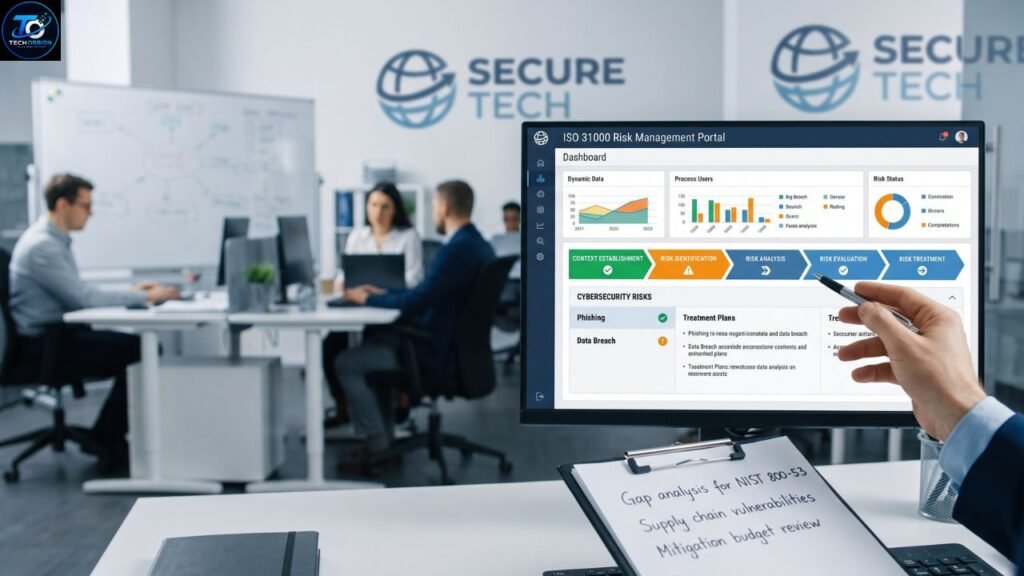
Many successful organizations use internationally recognized Risk Management Frameworks to strengthen operations and reduce uncertainty. Although industries differ, they all rely on structured processes to identify threats, evaluate risks, and implement appropriate controls. These real-world examples demonstrate how frameworks improve business performance while protecting critical assets.
The best organizations rarely rely on a single framework. Instead, they combine multiple standards that address governance, cybersecurity, operational performance, and regulatory compliance. This integrated approach creates stronger protection while supporting long-term organizational growth.
Healthcare Industry
Hospitals and healthcare providers commonly implement ISO 31000, NIST Cybersecurity Framework, and NIST RMF to protect patient records, manage cyber threats, maintain regulatory compliance, and ensure uninterrupted medical services.
Financial Services
Banks and financial institutions frequently adopt COSO ERM, FAIR Framework, and COBIT 2019 to reduce financial fraud, improve governance, strengthen cybersecurity, and comply with strict industry regulations.
Government Agencies
Government organizations widely implement the NIST Risk Management Framework because it provides structured guidance for protecting sensitive information systems while supporting continuous monitoring and regulatory oversight.
Manufacturing
Manufacturing companies use ISO 31000 and the OCTAVE Framework to manage operational risks, improve equipment reliability, strengthen supply chain resilience, and reduce production downtime.
Technology Companies
Technology organizations often combine NIST CSF 2.0, ISO/IEC 42001, and the AI Risk Management Framework to secure digital infrastructure, manage artificial intelligence responsibly, and protect customer information.
Framework Adoption by Industry
| Industry | Common Frameworks |
| Healthcare | ISO 31000, NIST RMF |
| Banking | COSO ERM, FAIR Framework |
| Government | NIST Risk Management Framework |
| Manufacturing | ISO 31000, OCTAVE Framework |
| Technology | NIST CSF 2.0, ISO/IEC 42001 |
Common Mistakes to Avoid
Even the strongest framework can fail if organizations overlook basic principles. Many businesses invest heavily in technology but neglect governance, employee awareness, or continuous monitoring. Others perform one-time assessments and assume their work is complete. Since business risks evolve continuously, successful organizations regularly review and improve their frameworks.
Avoiding common mistakes helps organizations reduce unnecessary costs while strengthening long-term resilience. Leadership should encourage collaboration, maintain updated documentation, and review framework performance regularly to ensure risk management remains effective.
Ignoring Emerging Risks
Organizations that focus only on historical threats often overlook new technologies, changing regulations, and evolving cyber risks. Continuous monitoring helps identify emerging threats before they become serious problems.
Poor Documentation
Incomplete documentation weakens accountability and complicates audits. Organizations should maintain an updated Risk Register, record treatment decisions, and clearly define Risk Ownership.
Infrequent Reviews
Business environments change quickly. Organizations should review policies, controls, and risk assessments regularly to maintain effectiveness and support Continuous Improvement.
Choosing the Wrong Framework
Every organization has unique objectives. Selecting a framework without considering business size, industry, regulatory requirements, and available resources often results in unnecessary complexity and poor implementation.
Lack of Employee Training
Employees remain the first line of defense against many operational and cybersecurity risks. Regular education strengthens awareness, reduces human error, and improves organizational preparedness.
Common Mistakes and Solutions
| Mistake | Recommended Solution |
| Ignoring new threats | Monitor risks continuously |
| Weak documentation | Maintain accurate records |
| Rare framework reviews | Schedule periodic assessments |
| Wrong framework selection | Match framework to business needs |
| Limited employee awareness | Provide ongoing training |
Frequently Asked Questions (FAQs)
What is a Risk Management Framework?
A Risk Management Framework is a structured system that helps organizations identify, evaluate, treat, monitor, and communicate risks while supporting strategic objectives and regulatory compliance.
Which Risk Management Framework is best?
There is no single best framework. ISO 31000 works well for general enterprise risk management, while NIST Risk Management Framework and NIST CSF 2.0 are excellent choices for cybersecurity-focused organizations.
What is the difference between ISO 31000 and NIST RMF?
ISO 31000 provides broad enterprise risk management guidance for all industries, whereas NIST RMF focuses primarily on information security and cybersecurity risk management.
What are the seven steps of the NIST Risk Management Framework?
The seven steps are Prepare, Categorize, Select, Implement, Assess, Authorize, and Monitor. Together they provide a continuous approach to managing cybersecurity risks.
What is the difference between a Risk Management Framework and a Risk Management Process?
A framework establishes governance, policies, and organizational structure. The process describes the practical steps used to manage individual risks within that framework.
Is ISO 31000 mandatory?
No. ISO 31000 is a voluntary international standard. However, many organizations adopt it because it improves governance, resilience, and business performance.
What industries use Risk Management Frameworks?
Healthcare, banking, government, manufacturing, technology, education, energy, insurance, transportation, and retail organizations all use structured risk management frameworks.
How often should a Risk Management Framework be reviewed?
Most organizations review their framework at least once a year. However, significant business changes, mergers, cyber incidents, or new regulations may require more frequent updates.
How does AI improve risk management?
Artificial intelligence supports predictive analytics, automated monitoring, fraud detection, compliance management, and faster decision-making by analyzing large volumes of data in real time.
Can small businesses implement Risk Management Frameworks?
Yes. Small businesses can implement simplified frameworks that match their size, budget, and operational complexity. Starting with basic risk identification and regular reviews often provides significant long-term benefits.
Conclusion
Risk Management Frameworks have become an essential part of modern business success. Organizations that identify risks early, evaluate them carefully, and respond with structured strategies are better prepared to protect their assets, maintain customer trust, and achieve long-term growth. Rather than viewing risk management as a compliance requirement, successful organizations integrate it into daily decision-making, strategic planning, and organizational culture.
Whether your organization adopts ISO 31000, NIST Risk Management Framework, COSO ERM, COBIT 2019, FAIR Framework, or another recognized standard, the most important factor is consistent implementation and continuous improvement. As technology, regulations, and business environments continue to evolve, organizations that regularly review and strengthen their Risk Management Frameworks will remain more resilient, competitive, and prepared for future challenges.
Meta Description
Learn Risk Management Frameworks to identify risks, improve security, ensure compliance, and protect your business effectively.
