

Introduction
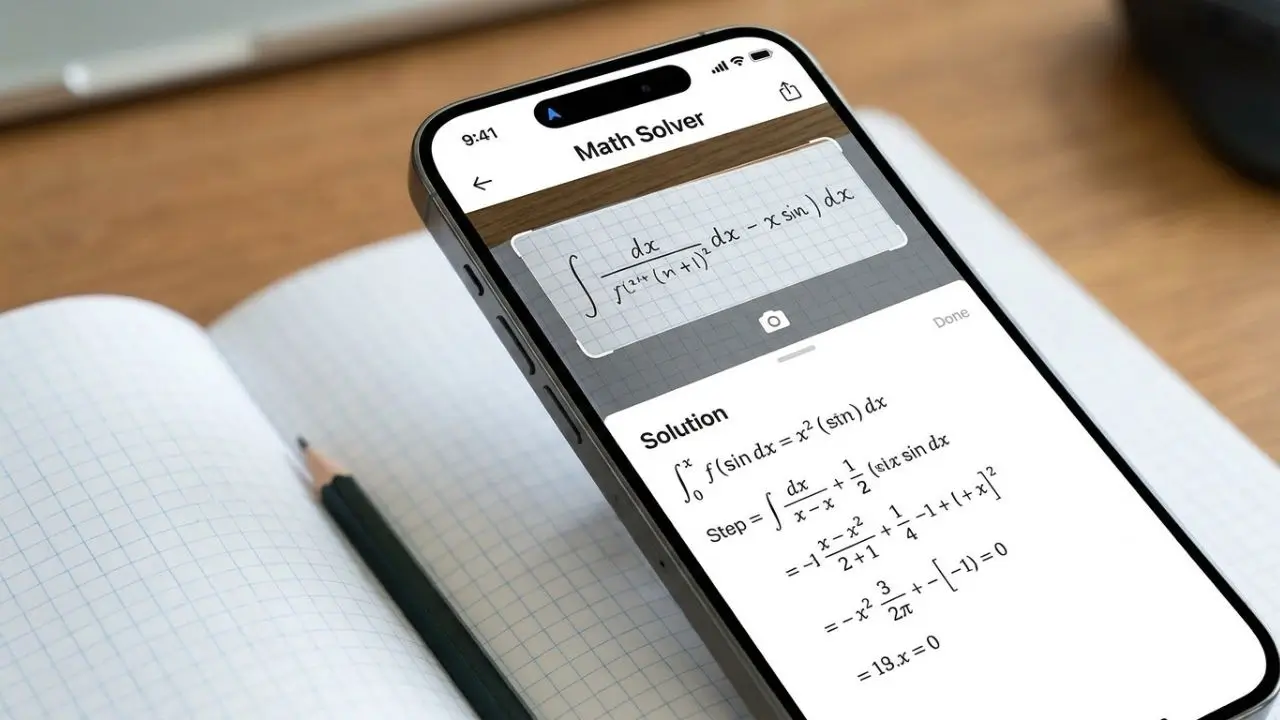
A math solver can sometimes come unstuck at a single line. Perhaps a formula is missing, a calculation step is unclear, or the problem was interpreted differently than intended. This is precisely where a math solver can be helpful. For those seeking extra support with math homework, “Math Homework Help” offers practical approaches to better understand problems and work through them step by step. Such tools can analyze math problems and—depending on the system—display not just the final result but also intermediate steps or explanations.
However, the true value of such a tool lies not in simply seeing a number appear on the screen as quickly as possible. Mathematics only becomes truly understandable when one can follow the process of arriving at a solution. A good math solver can therefore serve as a learning aid: it can verify a solution path, provide guidance on a difficult step, and pinpoint where an error might have crept in.
When used effectively, these tools can complement traditional practice. You first work on the problem yourself, then check your own solution path, and finally examine why a particular method works. In this way, a digital calculator transforms into a tool for deeper understanding.
When you need help solving a difficult mathematical problem, an AI-powered tool can make the process easier to understand. GN Math can be explored as an additional resource for working through math problems and understanding possible solutions. However, students should use such tools to learn the solving process rather than simply copying an answer.
What is a math solver and how does it work?

A math solver is a digital tool capable of calculating mathematical problems or assisting in their solution. Depending on the application, users can input numbers, formulas, equations, or other mathematical expressions. Some systems rely on standard text input, while others can also recognize images or handwritten math problems.
Anyone wishing to learn more about various digital tools can also use the AI Tools Guide to discover the different ways such tools can be applied.
Capabilities vary significantly from one tool to another. For a simple problem like 48 ÷ 6, a direct calculation suffices. In contrast, for an equation like 2x + 4 = 18, the system must first recognize that it needs to solve for a variable. A powerful solver can derive an appropriate solution path—showing, for instance, that one must first subtract 4 from both sides and then divide by 2.
From result to solution path
When learning, the method used to reach the answer is often more important than the result itself. Suppose the equation is:
3x – 7 = 14
First, add 7 to both sides:
3x = 21
Then, divide by 3:
x = 7
A solver that simply outputs “7” answers the question but does not explain how the solution was reached. A detailed breakdown of the intermediate steps is therefore particularly useful when the tool is used for educational purposes.
This does not mean that every solution provided by a digital system is automatically understood correctly. The learner should still verify the logic of the steps taken. For an equation, the solution can be checked by substitution, for example. For x = 7, the result is:
3 × 7 – 7 = 14
21 – 7 = 14
The calculation is correct.
What kind of math problems can a math solver help with?
Mathematics covers a wide range of topics, and digital solvers can handle different types of problems depending on their specific capabilities. Basic arithmetic operations are among their most fundamental functions; these include addition, subtraction, multiplication, and division. Many tools can also handle fractions, decimals, and percentage calculations.
Anyone wishing to practice mathematical fundamentals further can find free learning materials and exercises on various math topics at Khan Academy.
For a problem like 3/4 + 1/2, a common denominator must first be found. The second fraction can be written as 2/4. This results in:
3/4 + 2/4 = 5/4
The result can subsequently be expressed as the mixed number 1 1/4. A solver can help verify these conversions. Nevertheless, it is important to understand the mathematical reasoning behind each step.
Algebra and equations
Algebra is one area where a solver can be particularly useful. Equations involve variables and often require a series of sequential calculation steps.
Let’s take:
5x + 10 = 35
First, subtract 10 from both sides:
5x = 25
Then, divide by 5:
x = 5
More complex equations may require additional steps. A digital solver can serve as a tool for verification here. By working out the problem yourself first and then comparing your solution process, it is easier to identify exactly where any discrepancies arose.
Geometry, functions, and word problems
Geometry can also benefit from digital calculation aids. For a rectangle with a length of 12 cm and a width of 4 cm, the area is calculated as follows:
A = 12 × 4 = 48 cm²
With functions, on the other hand, one can examine table values, equations, or specific properties. Word problems present a particular challenge because the verbal information must first be translated into a mathematical structure.
This is precisely where caution is needed. A solver can calculate a mathematical equation that has been entered, but the most difficult task may well be formulating the correct equation from the text in the first place. Therefore, the problem statement should be read thoroughly before starting.
Using a Math Solver Effectively for Homework and Study

A solver is most useful when it supports your own thought process. If you simply enter a problem and copy the final answer, you skip the most important part of learning. A better approach is to first attempt to solve the problem yourself.
Suppose the problem is: “A sweater costs 80 euros. The price is reduced by 25 percent. How much does the sweater cost afterwards?” First, you can calculate it yourself:
80 × 0.25 = 20
Then:
80 – 20 = 60
Only then should you use a solver to check your work. If the result differs, the real learning begins: you look for the difference between the two solution methods.
Find the error instead of just copying the answer
Mistakes are a normal part of mathematics. What matters most is what happens next. If a student arrives at x = 9 for an equation while the solver indicates x = 7, they shouldn’t simply adopt the number 7.
Instead, the two solution paths can be compared. Perhaps a number was copied incorrectly. Perhaps a minus sign was overlooked, or an operation was performed on only one side of the equation. Understanding the cause of the error is far more valuable than simply knowing the correct number.
Using the solver to check your work
A sensible study routine can consist of four steps:
- Read the problem in full.
- Work out your own solution.
- Check the result using the Math Solver.
- Examine any discrepancies and correct errors.
This approach prevents the tool from becoming a substitute for independent thinking. At the same time, it gives the learner an additional way to verify their work.
Advantages and Limitations of a Math Solver
A major advantage of a math solver is speed. A complex calculation can be verified quickly. This is particularly useful when working through a large number of problems and wanting to check if a calculation error has crept in somewhere.
Another advantage is the ability to explore different mathematical representations. For instance, a fraction can be displayed as a decimal, or an equation can be solved for a specific variable. This can reveal relationships that are less obvious when calculating by hand.
Why a Solver Doesn’t Automatically Understand Every Problem
Digital tools operate based on the information provided to them. Consequently, an incorrectly entered problem can lead to an incorrect or inappropriate result.
Caution is especially important with word problems. If the text is misinterpreted and the wrong equation is entered, the solver might calculate that equation correctly without actually answering the original problem.
Mathematical notation also plays a role. Parentheses, negative numbers, fractions, and exponents must be entered correctly. For example, 2 × (3 + 4) yields 14, whereas 2 × 3 + 4 results in 10; the notation significantly changes the calculation.
Why human understanding remains important
Mathematics is not just about calculations. It also requires logical thinking, pattern recognition, and the ability to break a problem down into smaller parts.
For instance, a solver might show that the solution to an equation is x = 12. However, a student should still be able to understand why that solution makes sense and how to arrive at it independently when faced with a similar problem.
Therefore, the goal should not be to offload every calculation to a digital tool. Instead, the solver should be used in ways that support the learning process.
How to improve your math skills in the long run using a math solver
If you use a solver regularly, you should ensure that you do not lose your ability to solve problems independently. A simple approach is to work through a few problems without digital assistance first and use the solver only afterwards to check your work.
For example, if you are practicing ten equations, you could solve all ten yourself first. Then, check the results. For any incorrect answers, carefully review the solution steps. In this way, the tool becomes a kind of personal verification system.
Work with different difficulty levels
Mathematical understanding develops gradually. After simple tasks, the difficulty should be increased slowly. For example, anyone who is currently learning linear equations can initially work on equations with a single arithmetic operation. This is followed by tasks with several steps.
An example:
x + 8 = 15
initially becomes:
x = 7
After that, a task like:
3x + 8 = 20
follow.
Several steps are already required here:
3x = 12
x = 4
The solver can then check whether the solution is correct. However, as safety increases, the dependency on the tool should decrease.
Formulating Your Own Explanations
A particularly effective learning method is to explain your own problem-solving process in words. If a student can say, “First, I subtract 8 from both sides to isolate the variable,” it demonstrates a much deeper level of understanding than simply writing down “x = 4.”
This skill is also important for exams. Depending on the specific task, simply providing a numerical answer may not be enough; the steps taken to reach the solution may also be graded.

Using a Math Solver as a Study Partner, Not an Answer Machine
When used wisely, a math solver can be a valuable addition to studying mathematics. It can help verify answers, make complex calculations easier to follow, and sometimes offer a fresh perspective on a problem.
However, the tool should not take over the entire thinking process. Especially with homework, it is better to think about the problem yourself first. If you need help later on, a solver can provide a hint or allow you to check your work.
The distinction between “having a problem solved for you” and “understanding a problem” is crucial. Merely collecting answers does little to improve mathematical skills. In contrast, those who examine solution methods, analyze errors, and are subsequently able to solve similar problems on their own develop a genuine understanding.
Conclusion
A math solver can be a practical learning aid for many mathematical tasks. These tools offer various forms of support, ranging from basic arithmetic operations, fractions, and percentage calculations to equations, functions, and specific geometric calculations.
However, the greatest benefit is realized when the solver is not used as a substitute for independent thinking. Attempting to solve a problem yourself—followed by checking the result and analyzing any errors—transforms the digital tool into a meaningful learning aid.
Mathematics does not become easier simply by getting every answer immediately. It becomes easier when you understand which steps are necessary and why they work. That is precisely where a math solver can help.
Frequently Asked Questions about Math Solvers
1. What is a math solver?
A math solver is a digital tool capable of calculating mathematical problems or assisting in their solution. Depending on the specific tool, it can handle simple calculations, fractions, equations, functions, or other mathematical problems.
2. Can a math solver also solve equations?
Yes. Many math solvers can solve linear equations and, in some cases, more complex ones. For learning purposes, it is particularly helpful when the tool displays the individual steps of the calculation alongside the final answer.
3. Should I use a math solver to do my homework directly?
It is better to work through the problems yourself first and then use the solver to check your work. This keeps your own thought process active and allows you to analyze any errors in a targeted way.
4. Why might a math solver sometimes provide an incorrect answer?
Entering a problem incorrectly can lead to a wrong result. Ambiguous notation, missing parentheses, or incorrectly transcribed numbers can also alter the calculation. Therefore, you should always double-check your input.
5. Is a math solver useful for students?
Yes, provided it is used as a learning aid. It is particularly useful for checking answers, understanding calculation steps, and identifying one’s own mistakes.
