

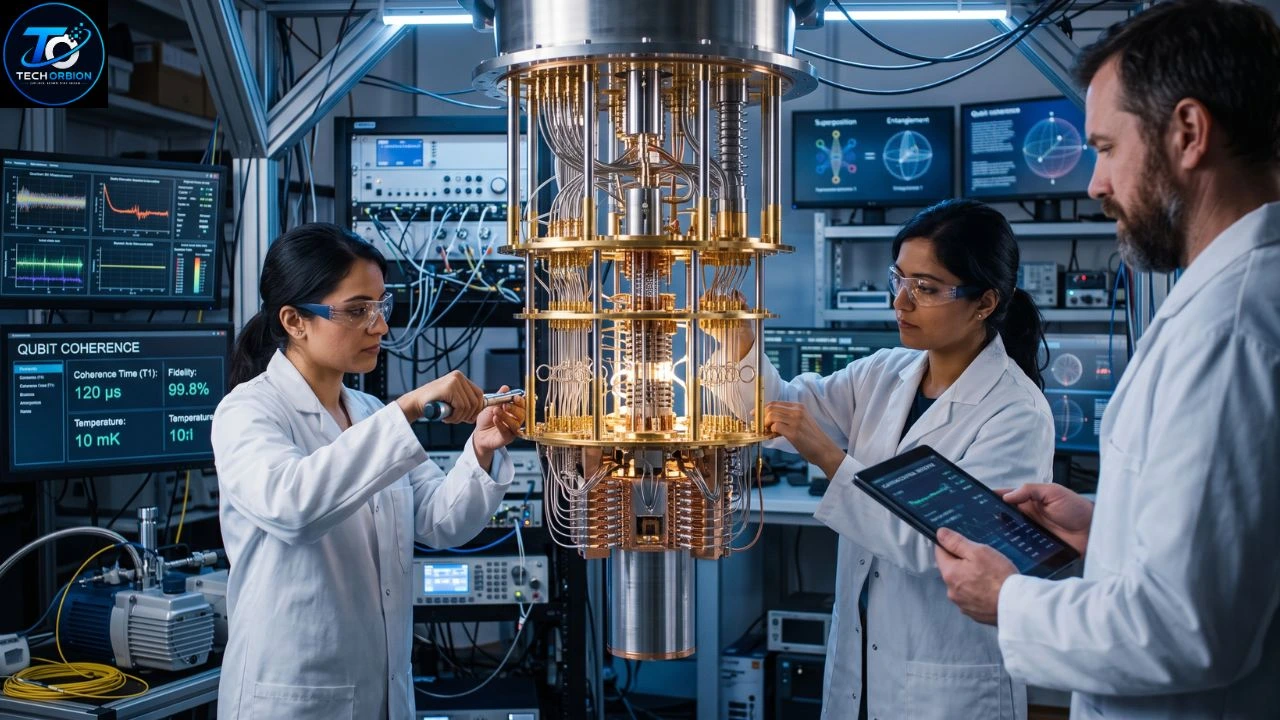
Quantum Technology is becoming one of the most advanced fields in modern science, combining the power of physics, computing, and engineering to solve complex problems. Unlike traditional systems, it uses the unique behavior of tiny particles to create new possibilities in communication, security, and computation. With the growth of Quantum Computing, researchers are developing machines that can handle difficult calculations beyond the limits of normal computers.
This emerging field also includes Quantum Sensors, quantum communication, and advanced security methods that may transform industries like healthcare, finance, and cybersecurity. As companies and governments invest in Quantum Research and innovation, quantum technology is moving closer to real-world applications. Although challenges remain, this Future Technology could become a major force behind scientific discoveries, digital transformation, and next-generation solutions.
Read our World Quantum Day guide to learn about the global celebration of quantum science.
What Is Quantum Technology?
Quantum Technology is a branch of science and engineering that uses the principles of Quantum Mechanics to create advanced tools, machines, and digital systems. Instead of relying only on traditional electronics, it takes advantage of the unusual behavior of Subatomic Particles such as electrons and Photons. These particles behave differently from objects in our everyday world, allowing scientists to design powerful solutions for computing, communication, sensing, and security.
Unlike ordinary digital systems, Quantum Technologies use quantum properties to process and store information in entirely new ways. This makes them useful for solving difficult Computational Problems, improving Cybersecurity, and supporting Scientific Research. Although many applications are still under development, several industries already use Quantum Sensors, Atomic Clocks, and advanced quantum devices to improve accuracy and performance.
Simple Definition
In simple words, Quantum Technology is technology built on the rules of Quantum Physics instead of traditional physics. It studies how extremely small particles behave and turns those behaviors into practical tools. Scientists use Atoms, light particles, and other quantum materials to build faster computers, more secure communication systems, and highly accurate measuring instruments.
One of the most exciting ideas behind this technology is Superposition, where Qubits can represent multiple states at the same time instead of using only Bits like ordinary computers. This unique ability allows a Quantum Computer to perform many calculations simultaneously, making certain tasks much faster than a Classical Computer.
How It Differs from Classical Technology
Traditional computers rely on Binary Code, where each bit stores either a 0 or a 1. This approach works well for everyday tasks such as web browsing, gaming, and office work. However, as problems become more complex, Classical Computing reaches performance limits because every calculation must follow a sequential process.
A Quantum Computer works differently by using Qubits, which can exist in multiple states through Superposition and Quantum Entanglement. Instead of replacing today’s computers, quantum machines will likely work alongside them to solve complex scientific simulations, optimize transportation networks, improve Drug Development, strengthen Data Protection, and support future Artificial Intelligence applications that require enormous computing power.
If you’re interested in this subject, don’t miss our [Future Technology] article.
How Quantum Technology Works
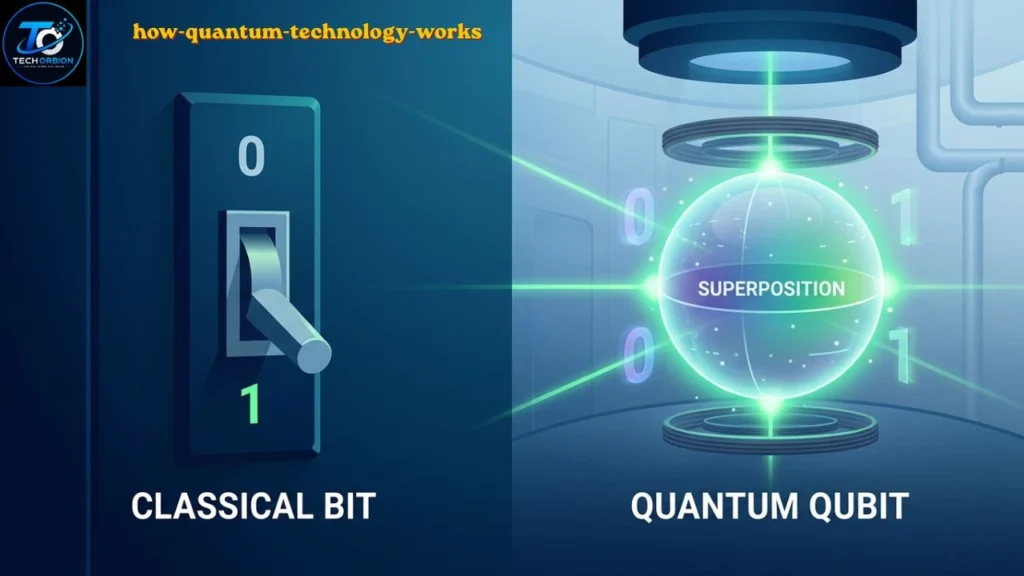
At its core, Quantum Technology uses the principles of Quantum Mechanics to process information in ways that traditional systems cannot. Instead of relying only on electrical signals, it takes advantage of the unusual behavior of Subatomic Particles such as electrons and Photons. These tiny particles follow different physical rules, allowing scientists to build faster, smarter, and more accurate systems for computing, communication, and sensing.
Unlike everyday computers, which process information one step at a time, quantum systems use Qubits instead of Bits. A regular bit stores either a 0 or a 1. However, a qubit can exist in multiple states at once because of Superposition. This unique property allows a Quantum Computer to perform many calculations simultaneously, making it ideal for solving complex Computational Problems that would take classical computers years to complete.
Quantum Mechanics Basics
Quantum Mechanics is the branch of physics that explains how extremely small particles behave. At the atomic level, Atoms and other particles do not always follow the same rules as larger objects. Scientists use these unusual behaviors to design Quantum Devices, improve Quantum Hardware, and create powerful Quantum Systems for scientific and commercial use.
One important idea in quantum mechanics is that observing a particle can change its behavior. This concept may seem strange, but researchers have confirmed it through decades of Scientific Research. Today, these discoveries support innovations in Quantum Communication, Quantum Imaging, Quantum Sensors, and many other areas of Emerging Technologies.
Superposition and Entanglement
Two of the most important concepts in Quantum Technology are Superposition and Quantum Entanglement. Superposition allows a qubit to represent multiple values at the same time, greatly increasing computing efficiency. This ability helps Quantum Computing analyze huge amounts of information much faster than Classical Computing for selected types of tasks.
Quantum Entanglement creates a strong connection between two quantum particles, even when they are separated by long distances. Changes to one particle instantly affect the other in measurable ways. Scientists are using this phenomenon to develop Quantum Cryptography, Quantum Key Distribution (QKD), and highly secure Quantum Communication systems that could strengthen Data Protection, improve Encryption, and support the future Quantum Internet.
History and Evolution of Quantum Technology
The story of Quantum Technology began in the early twentieth century when scientists discovered that tiny particles behaved differently from everyday objects. Researchers such as Max Planck, Albert Einstein, Niels Bohr, and Erwin Schrödinger helped build the foundation of Quantum Physics. Their discoveries transformed our understanding of matter and energy and opened the door to entirely new scientific possibilities.
Over the following decades, quantum theory moved from laboratories into practical applications. Technologies such as Atomic Clocks, lasers, and medical imaging systems demonstrated that quantum principles could solve real-world problems. In the 1990s and early 2000s, interest in Quantum Computing and Quantum Cryptography grew rapidly as researchers explored new ways to process information and protect digital communications.
Today, governments, universities, and private companies invest billions of dollars in Quantum Development and Quantum Innovation. Modern breakthroughs in Quantum Software, Quantum Algorithms, Quantum Hardware, and Quantum Engineering continue to push the field forward. As research progresses, Quantum Technology is expected to become one of the most influential drivers of Future Technology, creating opportunities across healthcare, finance, manufacturing, transportation, and Artificial Intelligence.
Types of Quantum Technology
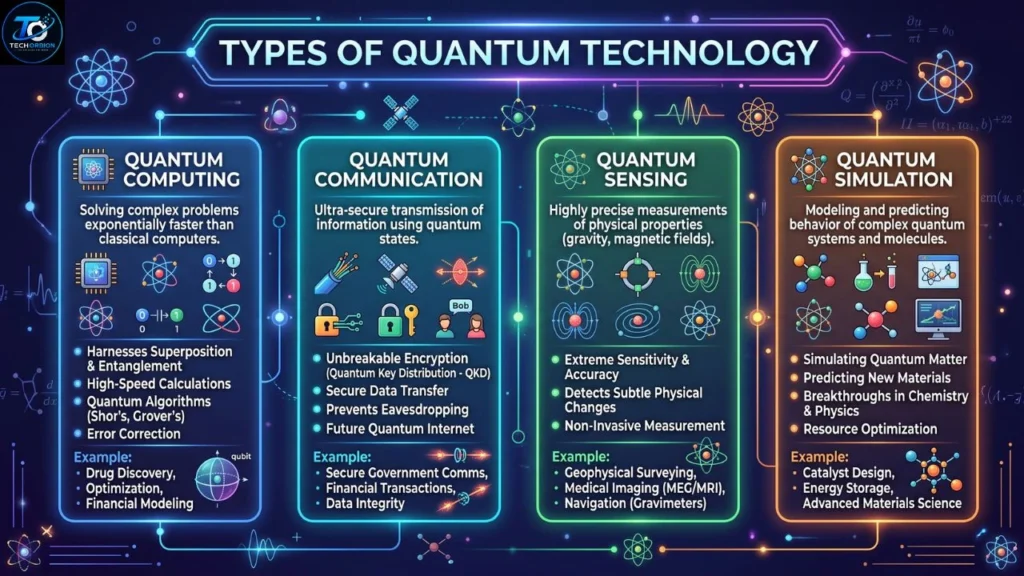
Quantum Technology is not limited to quantum computers. It includes several fields that use quantum principles to solve different problems. Each area focuses on a specific ability of quantum science, from processing information to protecting digital systems. Today, Quantum Technologies are developing across research labs, universities, and industries worldwide.
The four major areas include Quantum Computing, Quantum Communication, Quantum Sensing, and Quantum Cryptography. Together, these technologies form the foundation of the growing Quantum Industry and support future innovations in healthcare, security, science, and business.
Quantum Computing
Quantum Computing is the most recognized branch of quantum technology. It uses Qubits instead of traditional bits to perform advanced calculations. These systems are designed to solve complex challenges involving simulations, optimization, chemistry, and large-scale data analysis.
A Quantum Computer does not replace normal computers. Instead, it works alongside existing systems to handle specific tasks where traditional machines struggle. Companies and researchers are developing better Quantum Algorithms, improving Quantum Hardware, and creating reliable Quantum Software to make quantum computing more practical.
Quantum Communication
Quantum Communication focuses on sending information using quantum principles. It uses special quantum states to create safer communication channels that are extremely difficult to intercept without detection.
This technology plays an important role in building a future Quantum Network. Scientists believe quantum communication could improve Secure Communication between governments, businesses, and research organizations while supporting stronger Quantum Security systems.
Quantum Sensing
Quantum Sensors are highly sensitive devices that measure physical changes with incredible accuracy. They can detect tiny variations in gravity, time, movement, and magnetic fields that traditional sensors may miss.
For example, Quantum Gravity Sensors and Gravimeters can identify underground structures without large construction surveys. These tools may improve areas such as environmental research, transportation planning, and Infrastructure development.
Quantum Cryptography
Quantum Cryptography uses quantum principles to protect sensitive information. Unlike traditional security methods, it can detect attempts to observe or interfere with quantum communication.
One important technology in this field is Quantum Key Distribution (QKD). It allows two parties to share encryption keys while identifying unauthorized access attempts. Along with Post-Quantum Cryptography, this field aims to prepare digital systems for future security challenges caused by advanced Quantum Computers.
Key Components of Quantum Technology
Building advanced quantum systems requires several important components working together. These parts include quantum processors, specialized materials, control systems, and advanced software. Each element helps researchers create stable and reliable Quantum Systems.
The main components include:
| Component | Purpose |
| Qubits | Store and process quantum information |
| Quantum Processors | Perform quantum calculations |
| Quantum Algorithms | Provide instructions for solving problems |
| Quantum Software | Controls and manages quantum operations |
| Quantum Devices | Convert quantum principles into practical tools |
Quantum Hardware remains one of the biggest challenges because quantum states are extremely sensitive. Small environmental changes can create errors. Scientists use advanced cooling systems, precise controls, and error correction methods to maintain stable quantum operations.
At the same time, Quantum Software continues to improve. Developers create new programs that help researchers test quantum systems and discover useful applications. As hardware and software develop together, Quantum Commercialization becomes more achievable across different industries.
Real-World Applications of Quantum Technology
Quantum Technology is moving beyond research laboratories and entering real-world industries. Companies and governments are exploring how quantum systems can solve problems that traditional technology cannot handle efficiently. From healthcare discoveries to stronger security solutions, Quantum Applications are expanding rapidly across many sectors.
Although some quantum solutions are still in early stages, researchers believe they can create major improvements in science, business, and public services. The combination of Quantum Research, Advanced Computing, and Industrial Innovation is opening new opportunities that were previously impossible.
Healthcare
Healthcare is one of the most promising areas for Quantum Technology. Scientists are exploring how Quantum Computing can analyze complex biological data, simulate molecules, and support faster Drug Development. These capabilities may help researchers discover new medicines and understand diseases more accurately.
For example, quantum systems could simulate how different molecules interact inside the human body. This process may reduce the time needed for medicine development and improve personalized treatments. In the future, Quantum Sensors may also help create highly accurate medical devices for monitoring health conditions.
Finance
The finance industry handles enormous amounts of information every day. Quantum Computing may help financial organizations improve risk analysis, investment strategies, and fraud detection by solving complex mathematical problems faster.
Banks and investment companies are researching quantum-based solutions for portfolio optimization and market predictions. While traditional systems remain essential, quantum tools could provide additional power for advanced financial modeling and decision-making.
Cybersecurity
As digital threats continue growing, cybersecurity has become a major focus for Quantum Technology development. Powerful Quantum Computers may eventually break some existing Encryption methods, creating the need for stronger protection.
To prepare for this future, researchers are developing Quantum-Resistant Algorithms and advanced Post-Quantum Cryptography solutions. These technologies aim to protect sensitive information from future quantum-based attacks while improving overall Data Protection.
Find out how quantum computing is changing the future of Cybersecurity.
Manufacturing
Manufacturing companies are investigating quantum solutions to improve design, production, and supply chain management. Complex industrial problems often require massive calculations, and quantum systems may help discover more efficient solutions.
For example, quantum optimization could improve factory operations, material development, and energy usage. This could support cleaner production methods and encourage sustainable Industrial Innovation across different sectors.
Transportation
Transportation networks involve complicated planning challenges. Airlines, shipping companies, and logistics providers constantly search for better routes, schedules, and resource management methods.
Quantum Computing may improve route optimization, traffic management, and vehicle design. By analyzing large amounts of information quickly, quantum systems could help create more efficient transportation networks and reduce operational costs.
Defense
National security organizations are closely studying Quantum Technologies because of their impact on communication, sensing, and cybersecurity. Advanced quantum systems may improve surveillance, navigation, and secure information sharing.
However, governments must carefully manage these technologies through responsible Government Policy, Public Policy, and Technology Regulation. Balancing innovation with security will become increasingly important as quantum capabilities continue advancing.
Space Exploration
Space missions require extremely accurate measurements and advanced computing power. Quantum Timing, Optical Clocks, and Atomic Clocks already support technologies connected to satellites and GPS Technology.
Future quantum systems could improve spacecraft navigation, deep-space communication, and scientific measurements. As space exploration becomes more complex, quantum solutions may help researchers collect better data and operate missions more efficiently.
Quantum Computing vs Classical Computing
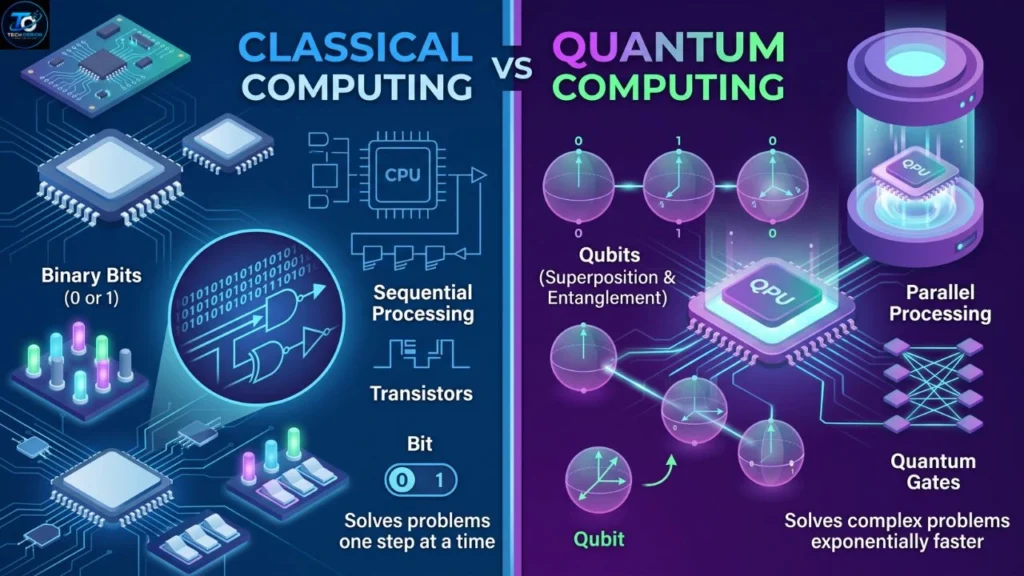
Quantum Computing and Classical Computing use completely different approaches to process information. Traditional computers rely on electrical circuits and Binary Code, while quantum machines use quantum principles such as Superposition and Quantum Entanglement.
A Classical Computer remains the best option for everyday activities like browsing, gaming, office work, and general software applications. However, a Quantum Computer may become valuable for specialized tasks involving complex simulations, optimization, and scientific research.
| Feature | Classical Computing | Quantum Computing |
| Information Unit | Bits | Qubits |
| Processing Method | Sequential calculations | Quantum-based calculations |
| Best For | Daily computing tasks | Complex scientific problems |
| Technology Stage | Mature and widely available | Developing rapidly |
The future will likely include both technologies working together. Instead of replacing traditional systems, quantum machines will support them by handling specific challenges. This combination of classical and quantum approaches may accelerate Digital Transformation and create new possibilities in Artificial Intelligence, research, and industry.
Benefits of Quantum Technology
Quantum Technology offers powerful advantages because it uses the unique behavior of quantum systems to solve difficult problems. While many applications are still developing, researchers believe quantum solutions could transform industries by improving speed, accuracy, and security. The impact may extend from scientific discoveries to everyday digital services.
One major benefit is the ability to handle complex tasks that traditional systems struggle with. Through Quantum Computing, advanced Quantum Algorithms, and improved Quantum Systems, organizations may discover new ways to analyze information, create products, and solve global challenges.
| Benefit | How It Helps |
| Faster calculations | Helps solve complex computational problems |
| Better security | Supports stronger quantum encryption methods |
| More accurate measurements | Improves sensing and timing technologies |
| Scientific breakthroughs | Helps researchers study complex systems |
Another important advantage is improved accuracy. Quantum Sensors can measure extremely small changes in gravity, movement, and energy. These capabilities may improve areas such as medical research, environmental monitoring, and infrastructure planning.
Faster Problem Solving
Many modern challenges require enormous computing power. Problems related to climate modeling, molecular simulation, and logistics involve millions of possible solutions. Quantum Computers may analyze these possibilities more efficiently than traditional machines.
For example, researchers can use quantum systems to simulate complex chemical reactions. This could accelerate Scientific Research and help companies develop better medicines, materials, and technologies.
Improved Data Security
Security is becoming more important as digital information continues expanding. Quantum-based security methods aim to create safer communication systems through advanced Quantum Cryptography and Quantum Encryption techniques.
Although future quantum computers may create risks for existing security systems, researchers are already developing solutions. Post-Quantum Cryptography and Quantum-Resistant Algorithms are designed to protect sensitive information against future threats.
Scientific Discoveries
Quantum technology can help scientists explore areas that were previously difficult to study. By creating accurate simulations and measurements, researchers can understand complex natural processes.
Fields such as physics, chemistry, biology, and astronomy may benefit from quantum tools. These advancements could lead to discoveries that improve medicine, energy production, and environmental solutions.
Challenges and Limitations of Quantum Technology
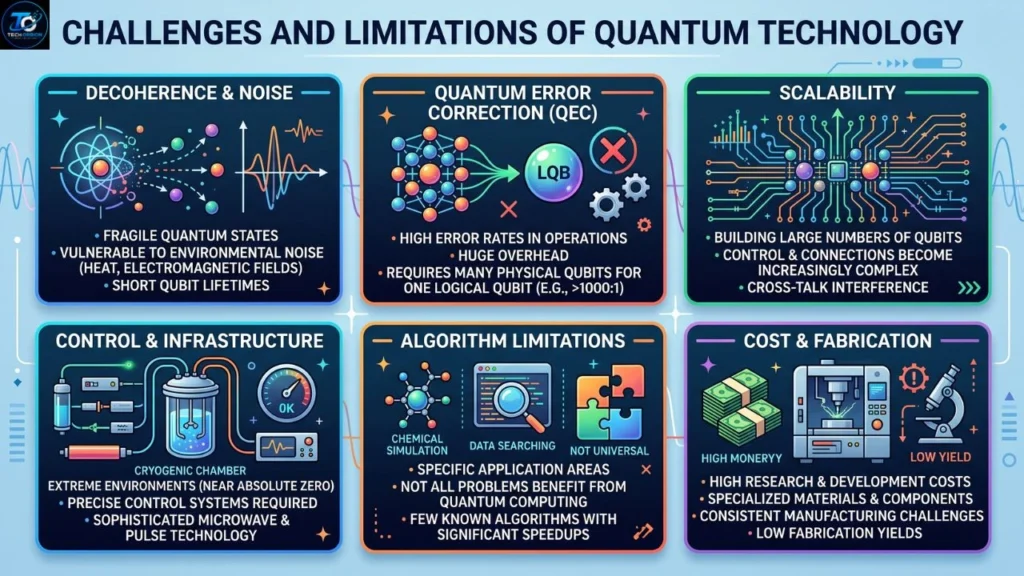
Although Quantum Technology has enormous potential, it also faces several challenges. Building practical quantum systems requires advanced engineering, expensive equipment, and highly skilled experts. Researchers are making progress, but large-scale adoption will take time.
Quantum systems are extremely sensitive. Even small environmental changes can affect performance. Scientists continue working on improving stability, reducing errors, and creating reliable Quantum Hardware for commercial use.
| Challenge | Explanation |
| Technical complexity | Quantum systems require advanced engineering |
| Error correction | Quantum states are easily disturbed |
| High costs | Research and equipment require major investment |
| Limited expertise | Few professionals specialize in quantum fields |
Hardware Complexity
Developing reliable quantum machines is one of the biggest challenges. Unlike normal computers, quantum devices need extremely controlled environments to maintain quantum states.
Many systems require very low temperatures and specialized equipment. This makes Quantum Engineering complicated and expensive compared to traditional technology development.
Error Correction
Quantum information is fragile. External interference can cause errors that affect calculations. Scientists are developing advanced error correction techniques to improve accuracy.
Creating stable Qubits remains a major goal in Quantum Research. Better error correction will help move quantum computers from experimental machines toward practical commercial systems.
High Development Costs
Quantum research requires significant investment from governments, universities, and private companies. Building quantum processors, testing systems, and training experts all require large resources.
However, increased funding is helping expand the Quantum Industry. As technology improves and more companies enter the market, costs may gradually decrease.
Skilled Workforce Shortage
Quantum technology requires knowledge across multiple fields, including physics, computer science, mathematics, and engineering. There is currently a shortage of professionals with advanced quantum skills.
To support future growth, universities and organizations are investing in education and training programs. Developing a strong Innovation Ecosystem will be essential for successful Quantum Commercialization.
Quantum Technology in Artificial Intelligence
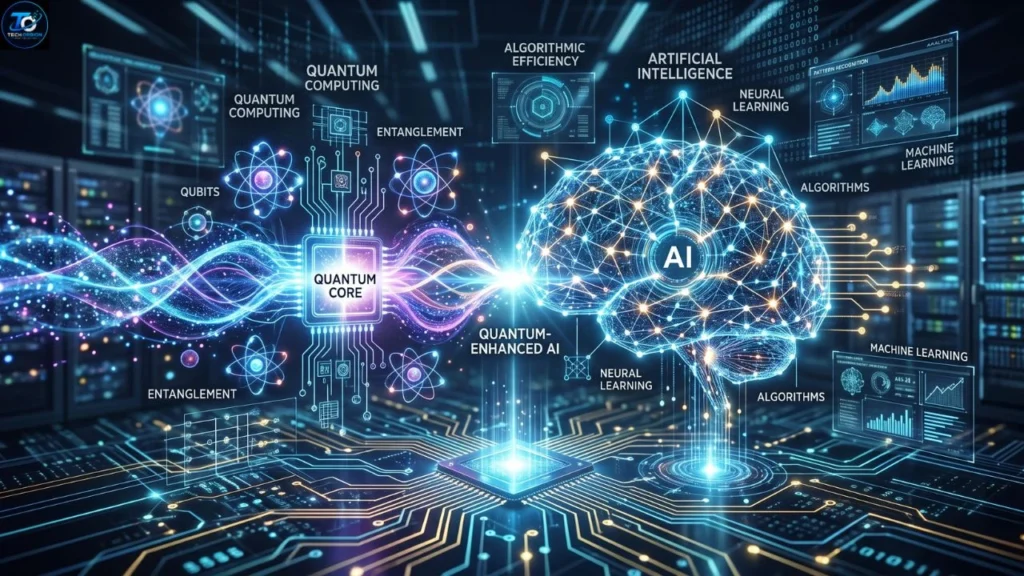
The relationship between Quantum Technology and Artificial Intelligence is becoming one of the most exciting areas of modern research. Quantum systems may improve AI by helping machines process complex information faster and discover patterns in massive datasets.
Researchers are exploring Quantum Machine Learning, which combines quantum computing principles with AI methods. This emerging field could improve optimization, prediction models, and advanced decision-making systems.
Quantum Machine Learning
Machine Learning requires powerful computing resources to analyze large amounts of data. Quantum approaches may improve certain algorithms by exploring multiple possibilities more efficiently.
Although quantum AI is still experimental, researchers believe it could support future breakthroughs in areas such as healthcare analysis, financial modeling, and scientific discovery.
AI Optimization
Many AI systems depend on optimization problems. Finding the best solution among millions of choices can require significant computing power.
Quantum Algorithms may help AI systems search through complex possibilities faster. This could improve areas like logistics, robotics, and automated decision-making.
Future AI Applications
In the future, quantum-powered AI may support advanced technologies such as personalized medicine, intelligent automation, and climate modeling. However, experts expect quantum and traditional AI systems to work together rather than completely replace existing approaches.
The combination of Artificial Intelligence, Quantum Computing, and Deep Technology may become a major driver of innovation in the coming years.
Quantum Technology in Cybersecurity
As digital threats become more advanced, Quantum Technology is creating new opportunities and challenges in cybersecurity. Modern security systems depend heavily on mathematical methods to protect information. However, future Quantum Computers may become powerful enough to break some current encryption techniques, making stronger protection methods necessary.
To prepare for this possibility, researchers are developing Quantum Security solutions that can defend sensitive information against future attacks. Governments, businesses, and technology organizations are investing in new security standards to protect financial records, personal data, and critical infrastructure.
Post-Quantum Cryptography
Post-Quantum Cryptography focuses on creating security methods that can resist attacks from powerful quantum computers. Instead of depending on encryption methods that may become vulnerable, these algorithms use new mathematical approaches designed for long-term protection.
Organizations such as government agencies and technology companies are testing Quantum-Resistant Algorithms to prepare digital systems for the future. This transition is important because sensitive data stored today could potentially be targeted by future quantum systems.
Secure Communications
One of the most promising areas of quantum security is Quantum Key Distribution (QKD). This technology uses quantum principles to share encryption keys between two parties while detecting unauthorized attempts to access the information.
Through Quantum Communication, organizations may create highly secure networks for protecting valuable data. Although QKD is still developing, it represents an important step toward safer digital communication and the future Quantum Internet.
Future Security Risks
While quantum technology can improve cybersecurity, it also creates new concerns. Criminal groups and governments may attempt to develop quantum capabilities for offensive purposes.
Because of this, responsible Technology Regulation, Government Policy, and international cooperation will play important roles. Preparing early will help organizations maintain strong Data Protection standards as quantum systems continue evolving.
Top Companies Leading Quantum Technology
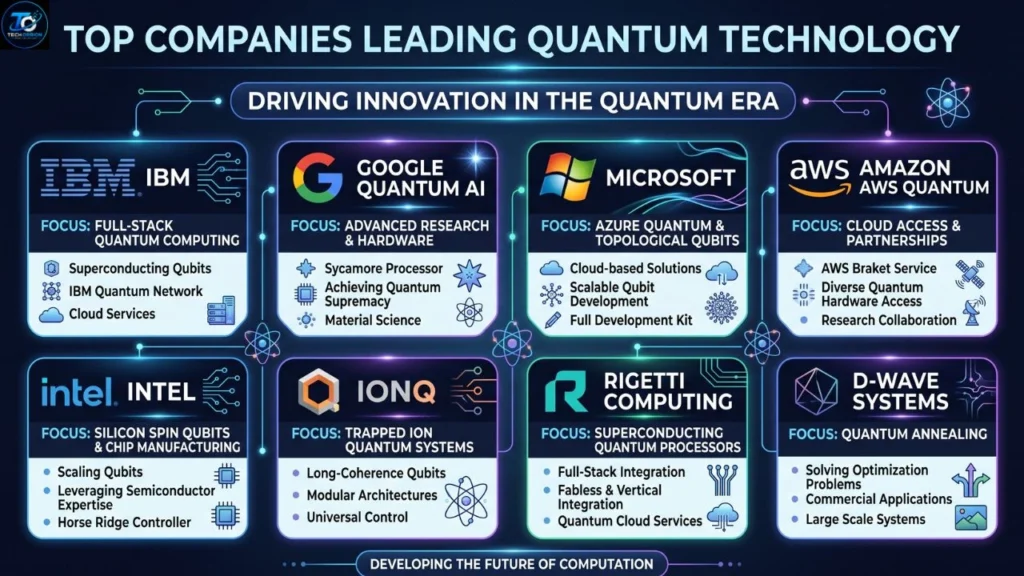
The growth of Quantum Technology is supported by major technology companies, research organizations, and innovative Quantum Startups. These companies are developing quantum processors, software platforms, and practical applications that may shape the future of computing.
Many leaders in the field are focusing on different approaches because there is no single perfect method for building quantum systems. Some companies focus on hardware development, while others create quantum software and cloud-based services.
| Company | Main Focus |
| IBM | Quantum processors, cloud quantum services |
| Google Quantum AI | Quantum computing research |
| Microsoft | Quantum software and hardware development |
| Intel | Quantum chips and semiconductor research |
| IonQ | Trapped-ion quantum computers |
| Rigetti Computing | Quantum processors and cloud platforms |
IBM
IBM is one of the most recognized names in the quantum industry. The company has developed quantum processors and provides access to quantum systems through cloud platforms.
Through its IBM Quantum program, the company supports researchers, developers, and businesses exploring Quantum Computing applications. IBM continues improving Quantum Hardware, software tools, and quantum education programs.
Learn more about quantum research from IBM Quantum.
Google Quantum AI
Google Quantum AI focuses on developing advanced quantum processors and exploring the future potential of quantum computing. The company gained attention through research on quantum performance and computational experiments.
Google continues studying Quantum Algorithms, error correction, and scalable quantum systems. Its research contributes to the broader understanding of how quantum computers may solve specialized problems.
Microsoft
Microsoft is building a quantum ecosystem that combines hardware research, software development, and cloud services. The company focuses on making quantum technology more accessible for businesses and researchers.
Through its quantum platform, Microsoft supports developers working with Quantum Software and quantum applications. Its long-term goal is creating reliable and scalable quantum systems.
Intel
Intel brings decades of semiconductor experience into the quantum field. The company researches quantum chips, processors, and manufacturing methods that could improve future quantum machines.
By combining traditional computing expertise with Quantum Engineering, Intel aims to create practical quantum solutions that can work alongside existing technologies.
IonQ
IonQ specializes in trapped-ion quantum computing technology. Its approach uses charged atoms to create stable quantum systems with high accuracy.
The company provides quantum computing access through cloud platforms and works with organizations exploring real-world Quantum Applications.
Rigetti Computing
Rigetti Computing develops quantum processors and cloud-based quantum computing services. The company focuses on making quantum systems available for developers and businesses.
Its work contributes to the growing Quantum Industry by improving quantum hardware access and encouraging innovation across different sectors.
Countries Investing in Quantum Technology
Governments around the world recognize that Quantum Technology could influence economic growth, national security, and scientific leadership. Many countries are investing in research programs, education, and quantum infrastructure to compete in this emerging field.
These investments support Quantum Research, innovation programs, and partnerships between governments, universities, and private companies. The goal is to build strong quantum ecosystems that encourage long-term development.
| Country/Region | Quantum Focus |
| United States | Quantum computing, cybersecurity, research funding |
| China | Large-scale quantum communication networks |
| European Union | Quantum research programs and collaboration |
| Canada | Quantum science and startup development |
| United Kingdom | Quantum strategy and innovation |
| Japan | Quantum computing and industrial applications |
The United States continues expanding quantum research through government programs and private investment. Federal organizations support development in areas such as computing, communication, and security.
China has invested heavily in quantum communication and research infrastructure. The country has developed experimental quantum networks and continues expanding its capabilities.
European countries are working together through large-scale initiatives focused on quantum science, education, and commercial development. These efforts aim to strengthen Europe’s position in the global Quantum Industry.
Latest Trends in Quantum Technology (2026)
In 2026, Quantum Technology continues moving from experimental research toward practical applications. Although fully mature quantum computers are still developing, companies and governments are making steady progress in building useful quantum systems. The focus has shifted from simply creating powerful machines to finding real solutions for industries.
Several trends are shaping the future of Quantum Technologies, including better hardware, improved software, stronger security methods, and wider commercial adoption. These developments are helping the Quantum Industry move closer to real-world impact.
| Trend | Impact on Quantum Technology |
| Fault-tolerant quantum computing | Creates more reliable quantum systems |
| Quantum networking | Enables future secure communication |
| Hybrid computing | Combines classical and quantum systems |
| Commercial quantum services | Makes quantum tools accessible to businesses |
Fault-Tolerant Quantum Computing
One of the biggest goals in quantum research is creating fault-tolerant systems. Current quantum machines experience errors because quantum states are extremely sensitive.
Scientists are improving Quantum Error Correction methods to create more stable Quantum Computers. Reliable error correction will allow quantum systems to perform longer and more complex calculations.
Quantum Networking
The development of a Quantum Network is another important trend. Researchers are exploring ways to connect quantum devices over long distances while maintaining secure information transfer.
Future quantum networks may improve Quantum Communication, strengthen Secure Communication, and support advanced security systems using quantum principles.
Hybrid Quantum-Classical Systems
Rather than replacing traditional computers, quantum machines will likely work together with existing systems. Hybrid computing combines Classical Computing with quantum technologies to achieve better performance.
This approach allows businesses to use quantum advantages while continuing to rely on traditional computers for everyday tasks.
Commercial Quantum Services
Cloud-based quantum platforms are making quantum technology more accessible. Companies can now experiment with quantum systems without owning expensive hardware.
This growth supports Quantum Commercialization by allowing researchers, developers, and businesses to test new Quantum Applications in areas such as finance, healthcare, and engineering.
Future of Quantum Technology
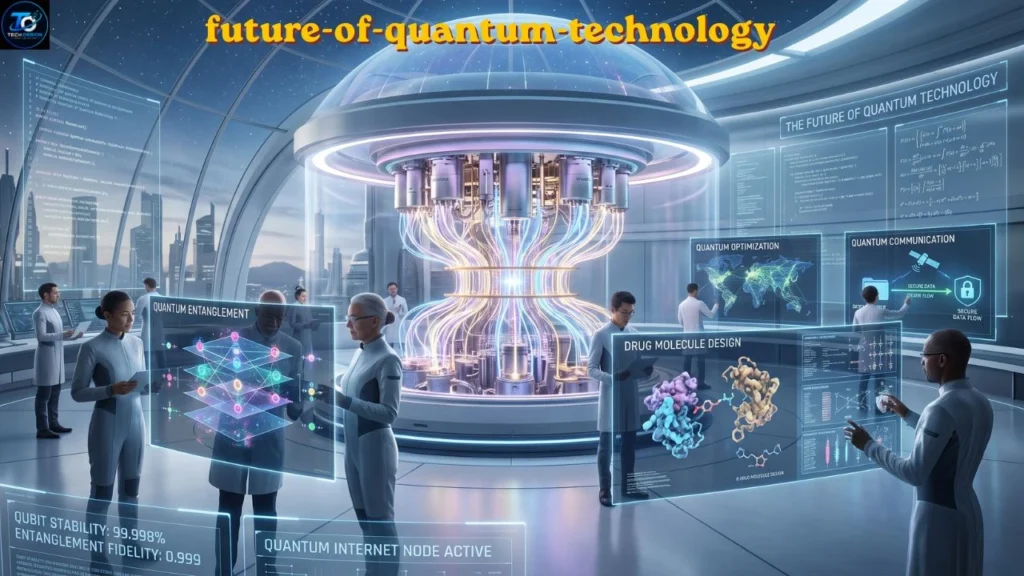
The future of Quantum Technology looks promising as researchers continue improving hardware, software, and practical applications. While some predictions about quantum technology are exaggerated, experts agree that it has the potential to create major changes in specific industries.
Over the next decade, quantum systems may become valuable tools for solving complex problems related to medicine, energy, security, and scientific discovery. However, progress will depend on continued investment, research, and responsible development.
Next 10 Years
During the next decade, scientists expect major improvements in Quantum Computing, quantum sensors, and communication systems. More reliable quantum processors may allow companies to explore applications that are currently impossible.
Industries may begin using quantum tools for specialized tasks such as molecular simulation, optimization, and advanced analysis. These improvements could accelerate innovation across many sectors.
Industry Predictions
Experts believe quantum technology will not replace existing technology overnight. Instead, it will become another important layer of modern computing.
Similar to how the internet transformed communication and AI transformed data processing, quantum technology may become a powerful tool for solving difficult challenges. The combination of Artificial Intelligence, Advanced Computing, and quantum systems may create new opportunities.
Emerging Opportunities
The growth of quantum technology will create new career paths and business opportunities. Fields such as quantum programming, quantum engineering, cybersecurity, and scientific research will require skilled professionals.
As the Innovation Ecosystem grows, more Quantum Startups and established companies will explore commercial solutions. This expansion may increase investment and accelerate Digital Transformation worldwide.
Is Quantum Technology Safe?
Like any powerful technology, Quantum Technology brings both opportunities and risks. The technology itself is not dangerous, but its applications require careful planning and responsible management.
Quantum systems can improve security, research, and communication. However, they may also create challenges related to privacy, cybersecurity, and global competition. Careful Technology Regulation will help ensure quantum development benefits society.
Security Considerations
The biggest security concern involves future quantum computers breaking current encryption methods. This is why researchers are developing Post-Quantum Cryptography and stronger security standards.
Organizations must prepare early by updating security systems and protecting important information from future threats.
Ethical Concerns
Quantum technology raises ethical questions about access, control, and responsible use. Advanced technologies should be developed in ways that support fairness and public benefit.
Clear guidelines can help governments and companies use quantum innovations responsibly while avoiding unnecessary risks.
Regulatory Challenges
Governments face the challenge of encouraging innovation while protecting national interests. Strong Public Policy and cooperation between Policymakers will become essential.
International collaboration can help create balanced rules for quantum development and prevent misuse of advanced quantum capabilities.
Common Myths About Quantum Technology
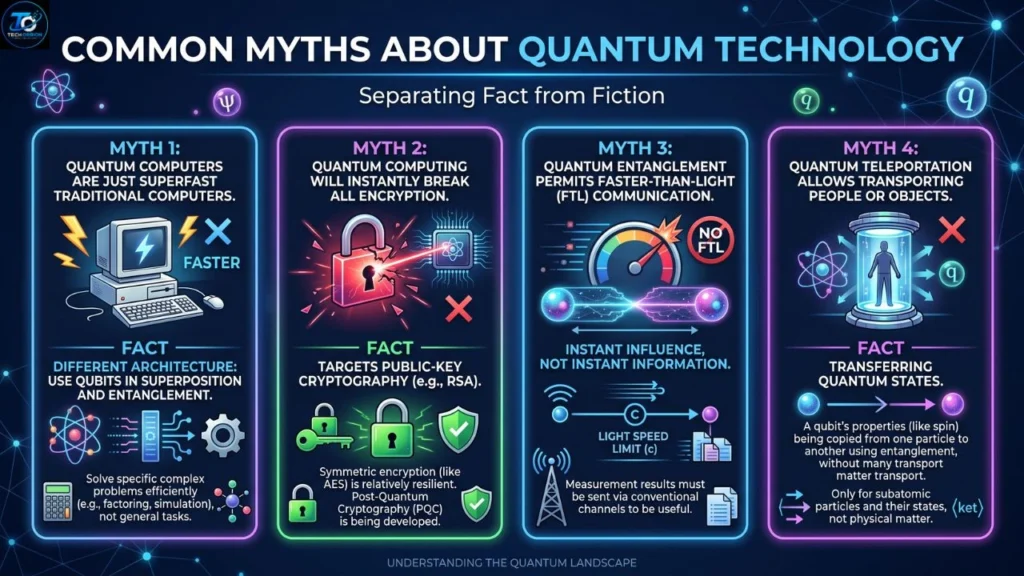
Because Quantum Technology sounds complex, many misunderstandings surround it. Some people believe quantum computers will instantly replace all computers or solve every problem. In reality, quantum systems are specialized tools designed for specific challenges.
Understanding the difference between facts and myths helps people see the real potential of this technology.
| Myth | Reality |
| Quantum computers replace normal computers | They work alongside classical systems |
| Quantum technology is only about computers | It includes sensors, communication, and security |
| Quantum computers are available everywhere | They are still developing |
| Quantum technology solves every problem | It works best for specific tasks |
Myth: Quantum Computers Are Faster at Everything
A common misconception is that quantum computers are always faster than traditional machines. In reality, they are designed for specific types of calculations.
A normal computer remains better for most daily activities, while quantum systems focus on highly complex challenges.
Myth: Quantum Technology Is Science Fiction
Although quantum technology sounds futuristic, many quantum-based tools already exist today. Atomic Clocks, quantum sensors, and other devices are already used in scientific and industrial environments.
The future development of quantum technology is based on real scientific progress rather than imagination.
Myth: Quantum Technology Is Only for Scientists
Quantum technology is not limited to laboratories. Businesses, governments, developers, and students are becoming involved as the field grows.
As education and tools improve, more people will participate in the expanding Quantum Industry and its future applications.
Frequently Asked Questions (FAQs)
What Is Quantum Technology Used For?
Quantum Technology is used for solving complex problems that traditional technologies may struggle with. Its applications include Quantum Computing, secure communication, advanced sensing, and scientific research. Industries such as healthcare, finance, cybersecurity, and transportation are exploring quantum solutions to improve accuracy, speed, and decision-making.
In the future, quantum systems may support Drug Development, climate research, and advanced engineering. However, most applications are still developing, and researchers continue testing how quantum tools can provide practical benefits.
Is Quantum Technology the Same as Quantum Computing?
No, Quantum Computing is only one part of Quantum Technology. Quantum technology is a broader field that includes quantum computers, quantum sensors, quantum communication, and quantum security solutions.
A Quantum Computer focuses on processing information using Qubits, while technologies like Quantum Sensors measure extremely small changes in the environment. Together, these areas create a complete quantum ecosystem.
Can Quantum Computers Replace Classical Computers?
Quantum computers are not expected to replace Classical Computers completely. Traditional computers are excellent for everyday activities such as browsing, gaming, and business software.
Instead, quantum machines will likely work alongside existing systems. A Classical Computer may handle normal tasks while a quantum system solves specialized problems involving complex calculations and simulations.
Why Is Quantum Technology Important?
Quantum technology is important because it introduces new ways to process information, measure the world, and secure communication. It can help scientists solve problems that require enormous computing power.
Through Quantum Research, Quantum Innovation, and Quantum Engineering, researchers are creating tools that may transform industries and support future discoveries.
Are Quantum Computers Available Today?
Yes, quantum computers already exist, but they are mainly used for research, testing, and specialized experiments. Companies provide access through cloud platforms where developers and scientists can experiment with quantum systems.
However, large-scale commercial quantum computers are still being developed. Scientists continue improving Quantum Hardware, software, and error correction methods.
What Companies Are Leading Quantum Technology?
Several major technology companies are investing in quantum research. Organizations such as IBM, Google, Microsoft, Intel, IonQ, and Rigetti Computing are developing quantum hardware, software, and services.
These companies are working on different approaches to improve Quantum Systems, expand quantum access, and create practical Quantum Applications.
How Does Quantum Technology Affect Cybersecurity?
Quantum technology has both positive and negative effects on cybersecurity. Powerful future quantum computers could threaten some existing encryption methods.
At the same time, quantum solutions such as Quantum Cryptography, Quantum Key Distribution (QKD), and Quantum-Resistant Algorithms are being developed to create stronger protection methods.
What Is the Future of Quantum Technology?
The future of quantum technology looks promising as research continues worldwide. Experts believe it may improve areas such as healthcare, artificial intelligence, communication, and scientific discovery.
As the Quantum Industry grows, more businesses and governments will explore quantum solutions. The next decade will likely bring important advances in Quantum Development and commercialization.
Conclusion
Quantum Technology represents one of the most exciting developments in modern science and engineering. By using the unique principles of Quantum Mechanics, it creates new possibilities in computing, communication, security, and measurement. Although the technology is still developing, its potential impact reaches far beyond laboratories.
From Quantum Computing and Quantum Cryptography to Quantum Sensors and quantum communication networks, these innovations may reshape industries in the coming years. Businesses, governments, and researchers are already investing heavily in Quantum Research because they believe it can solve problems that traditional systems cannot handle efficiently.
However, quantum technology is not a magic solution for every challenge. It comes with technical difficulties, high costs, and security concerns that require careful planning. Continued investment in Quantum Engineering, education, and responsible Technology Regulation will determine how successfully society adopts these innovations.
As we move toward 2026 and beyond, quantum technology will remain an important part of Future Technology. Whether improving healthcare, strengthening cybersecurity, or supporting advanced scientific discoveries, quantum systems are likely to become a valuable tool in the next generation of digital transformation.
Meta Description
Explore Quantum Technology and discover its applications, benefits, challenges, quantum computing, security, and future innovations.
