


Introduction
A data analyst helps people understand information by turning raw data into useful insights. Every day, businesses collect large amounts of data from websites, apps, sales, customers, and social media. Without someone to study that information, it becomes difficult to make smart decisions. That is where a data analyst plays an important role.
Many industries need data analysts today. Companies use them to improve products, increase sales, understand customer behavior, and solve business problems. The best part is that this career is open to people from many educational backgrounds if they are willing to learn the right skills. In this guide, you will learn what a data analyst does, the skills needed, career opportunities, common tools, benefits, mistakes to avoid, and answers to common questions. Whether you are a student or planning a career change, this article will help you understand the exciting world of data analysis.
A reliable laptop buying guide can help beginners choose the right device for data analysis work.
What Is a Data Analyst?

A data analyst is a professional who collects, cleans, studies, and explains data. Their job is to find useful patterns and help businesses make better decisions. Instead of guessing, companies use facts from data to solve problems.
For example, a clothing store may notice that winter jackets sell better in November than in October. A data analyst studies sales reports and helps the company prepare more stock before demand increases.
Data analysts work with numbers, charts, and reports. They turn confusing information into simple insights that managers and business owners can understand.
Their work supports better planning, smarter marketing, and improved customer service. Almost every business today depends on data to grow.
Why Data Analysis Is Important
Modern businesses collect information every second. Online stores track purchases, schools record student progress, and hospitals store patient information. This data becomes valuable only when someone understands it.
A data analyst helps organizations make decisions based on facts instead of opinions. This reduces mistakes and improves results.
For example, a restaurant owner may wonder why fewer customers visit on weekdays. By studying customer data, a data analyst might discover that people prefer weekend discounts. The owner can then create weekday offers to attract more visitors.
Good data analysis also saves time and money by showing what works and what needs improvement.
Skills Every Data Analyst Needs
A successful data analyst needs both technical and personal skills. Learning these skills takes time, but beginners can improve through practice.
One important skill is problem-solving. Analysts ask questions, study information, and find answers using data. They also need attention to detail because even small mistakes can affect results.
Technical skills are also important. Many analysts use spreadsheet software, databases, and data visualization tools. Learning SQL, Excel, and basic programming can make work easier.
Communication is another valuable skill. Analysts must explain their findings in simple language so everyone can understand the results.
Curiosity also helps. Great analysts enjoy asking questions and discovering new insights.
Tools Used by a Data Analyst
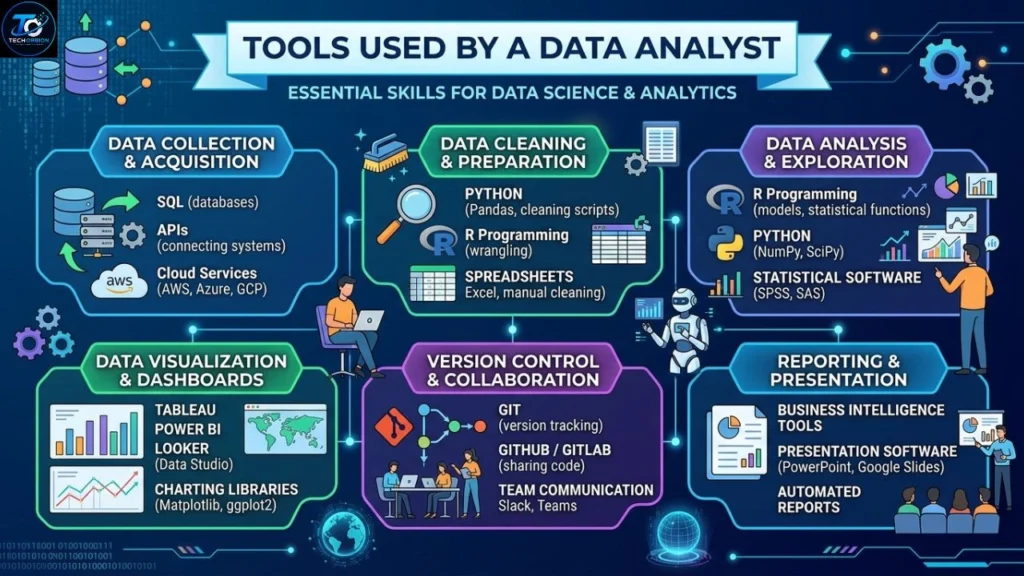
Data analysts use different tools depending on their work. Some tools help organize data, while others create charts and reports.
Microsoft Excel is one of the most common tools. It helps users sort data, perform calculations, and create graphs.
SQL is another popular tool. It allows analysts to retrieve information from databases quickly.
Many professionals also use Power BI or Tableau to create colorful dashboards. These dashboards help managers understand business performance at a glance.
Python and R are programming languages used for larger and more complex data projects. Beginners do not need to master everything at once. Learning one tool at a time builds confidence.
Steps in the Data Analysis Process
Every data analyst follows a basic process to solve problems.
The first step is collecting data from different sources. This may include websites, surveys, customer records, or sales reports.
Next comes cleaning the data. Analysts remove duplicate records, fix errors, and organize information so it becomes accurate.
After cleaning, they study the data to find trends and patterns. They compare numbers, create charts, and answer business questions.
Finally, they prepare reports and present their findings. These reports help business leaders make informed decisions.
Following this process keeps analysis organized and reliable.
Where Data Analysts Work
Data analysts are needed in many industries. Their skills are useful wherever people collect information.
Banks use analysts to detect fraud and improve financial services. Hospitals use them to study patient care and improve treatment.
Retail companies analyze customer buying habits. Schools use data to improve student performance. Technology companies rely on analysts to improve apps and websites.
Government offices also hire data analysts to study public services and plan future projects.
Because data is everywhere, job opportunities continue to grow across different industries.
How to Become a Data Analyst

Starting a career as a data analyst does not always require years of experience. Many people begin by learning basic skills through online courses, books, or college programs.
Practice is the key to success. Beginners should work on small projects using public datasets. Building a portfolio helps show employers what you can do.
Learning Excel, SQL, and one visualization tool is a great starting point. Later, you can learn Python or other advanced skills.
Internships and entry-level jobs provide valuable experience. Every project helps improve your confidence and problem-solving ability.
With regular practice, you can build a successful career step by step.
Challenges Data Analysts Face
Although this career is rewarding, it also comes with challenges.
Sometimes the data is incomplete or contains mistakes. Cleaning large datasets can take a lot of time.
Business managers may ask difficult questions that require careful analysis. Analysts must stay patient and think logically before giving answers.
Technology also changes quickly. New software and tools appear every year, so continuous learning is important.
Despite these challenges, many analysts enjoy solving problems and discovering valuable insights.
Future of the Data Analyst Career
The demand for data analysts continues to grow as businesses collect more information than ever before.
Artificial intelligence and automation are changing how companies use data. However, human analysts are still needed to understand results and make smart decisions.
Remote work has also created new opportunities. Many companies now hire analysts from different parts of the world.
People with strong analytical skills and a willingness to learn will continue to find exciting career opportunities in the future.
The field offers good job stability and many chances for career growth.
Learn more about data analyst career outlook and related occupations from the U.S. Bureau of Labor Statistics.
Benefits of Becoming a Data Analyst
- High demand across many industries.
- Good career growth opportunities.
- Competitive salaries in many countries.
- Opportunity to solve real business problems.
- Work with modern technology and tools.
- Develop valuable analytical thinking skills.
- Flexible remote work opportunities.
- Learn skills that are useful in many careers.
- Help businesses make smarter decisions.
- Continuous learning keeps the job interesting.
Common Mistakes Beginners Make
- Ignoring data cleaning before analysis.
- Focusing only on tools instead of problem-solving.
- Forgetting to check data accuracy.
- Creating reports that are difficult to understand.
- Using too many complicated charts.
- Not practicing with real-world projects.
- Ignoring communication skills.
- Trying to learn every tool at once instead of mastering the basics.
- Making conclusions without enough evidence.
- Giving up too quickly when facing difficult datasets.
Frequently Asked Questions
1. What does a data analyst do every day?
A data analyst collects, cleans, studies, and explains data. They create reports and help businesses make better decisions based on facts.
2. Do I need a degree to become a data analyst?
A degree can help, but many employers also value practical skills, certifications, and project experience. A strong portfolio is often very important.
3. Which programming language should beginners learn?
Python is one of the most popular choices because it is easy to learn and widely used for data analysis. SQL is also essential for working with databases.
4. Is data analysis a good career?
Yes. It offers strong job demand, career growth, competitive salaries, and opportunities in many industries around the world.
5. Can beginners learn data analysis from home?
Yes. Many people learn through online courses, practice projects, books, and tutorials. Regular practice is the best way to improve your skills.
Conclusion
A data analyst plays a valuable role in today’s digital world by turning raw information into meaningful insights. Businesses, schools, hospitals, governments, and technology companies all depend on data to make better decisions. This makes data analysis one of the most useful and rewarding career paths available today.
The journey may seem challenging at first, but learning one skill at a time makes it much easier. Start with the basics, practice using real data, and build small projects to improve your confidence. As your knowledge grows, so will your career opportunities. If you enjoy solving problems, working with numbers, and helping others make smarter decisions, becoming a data analyst could be the perfect career choice for your future.
