

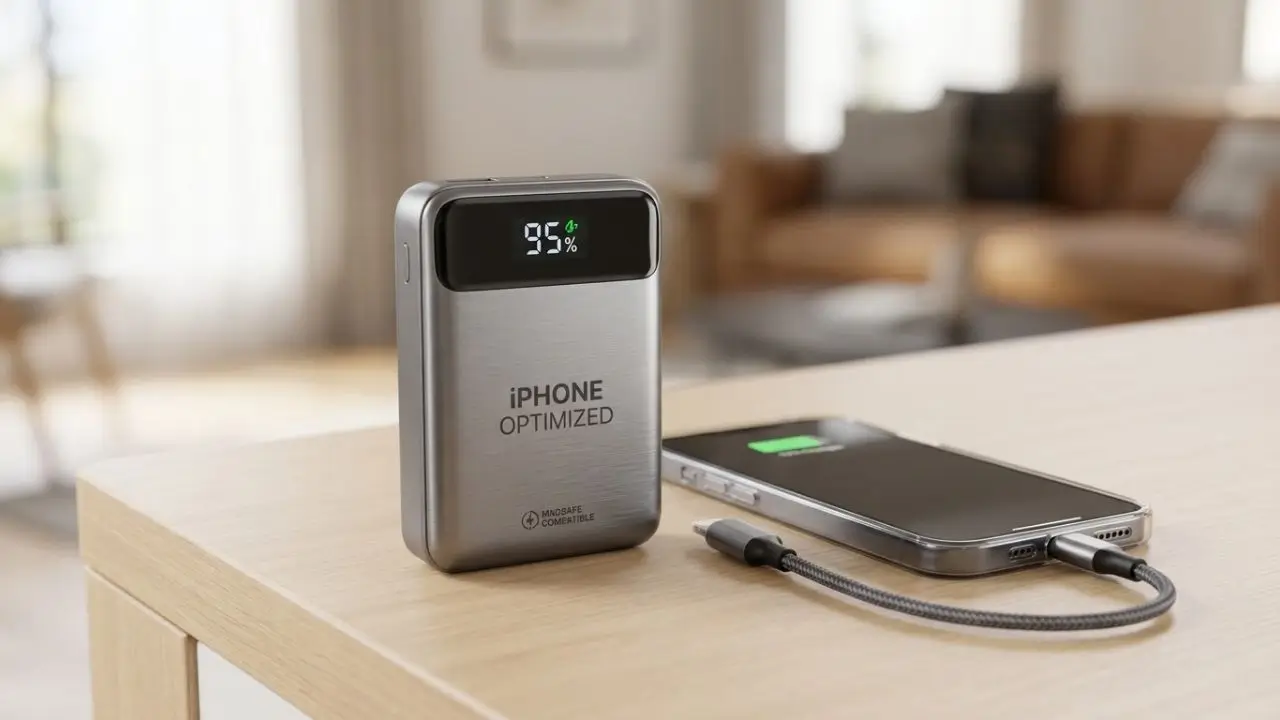
A dead iPhone battery rarely happens at a convenient time. Whether you are on a long trip, in the middle of the workday, taking photos, or out and about without access to a power outlet, a good power bank can be more than just a handy accessory; it ensures your smartphone stays ready for action exactly when you need it.
However, if you are looking for the best power bank for iPhone, you shouldn’t simply buy the model with the highest mAh rating. Size, weight, charging speed, ports, wireless charging capabilities, and compatibility with your specific iPhone model all play a crucial role. For instance, a massive power bank might store a lot of energy but prove too heavy for everyday use.
The type of iPhone matters, too. A newer model with USB-C has different requirements than an older iPhone with a Lightning port. Meanwhile, magnetic power banks may appeal to users who want to continue using their iPhone comfortably while it charges. This guide explains the key factors to consider so you can evaluate a power bank based on its actual utility rather than just the numbers.
If you would also like to compare smartphones themselves before buying accessories, our [Smartphone Buying Guide 2026] will help you make a choice based on battery, charging speed, display, and other key features.
What makes a power bank for the iPhone truly good?
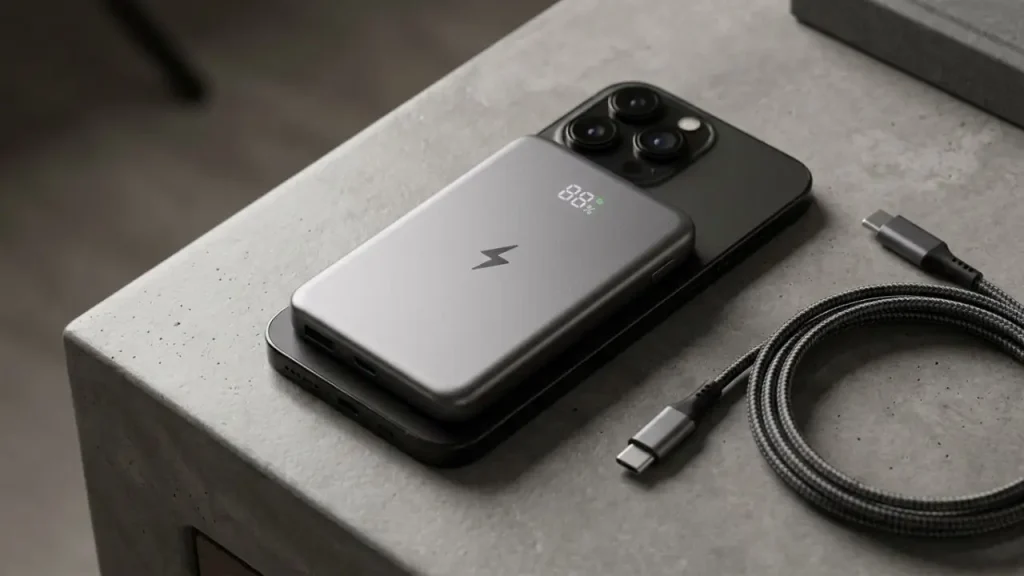
First and foremost, the best power bank for an iPhone should be reliable and easy to use. High capacity alone tells you little about how convenient the device is for everyday use. While a 20,000 mAh power bank can store significantly more energy than a small 5,000 mAh model, it is usually larger and heavier. Consequently, the smaller version may be more practical for a short outing.
Charging performance also warrants attention. Modern iPhones can charge much faster when connected to a sufficiently powerful power bank than when using a weak USB output. It is important to distinguish between the power bank’s maximum output and the power actually drawn by the iPhone; ultimately, the smartphone itself determines how much energy it can safely accept within its technical limits.
Capacity Does Not Equal Actual Charging Output
Power bank capacity is usually specified in mAh (milliampere-hours). While this figure is useful, it should not be interpreted to mean—for instance—that a 10,000 mAh power bank will deliver an exact number of full iPhone charges.
Energy is lost when converting stored power into the voltage required by the iPhone. Additionally, factors such as cables, temperature, charging electronics, and the battery’s condition affect actual performance. Consequently, the usable energy in practice is lower than the printed nominal capacity.
For everyday use, a compact power bank with a capacity of around 5,000 to 10,000 mAh can be very convenient. However, those who travel frequently or need to power multiple devices might benefit more from a capacity of 10,000 to 20,000 mAh. Even larger models are better suited for extended trips or situations where no power outlet is available for many hours.
MagSafe, magnetic charging, or cables: Which is better?
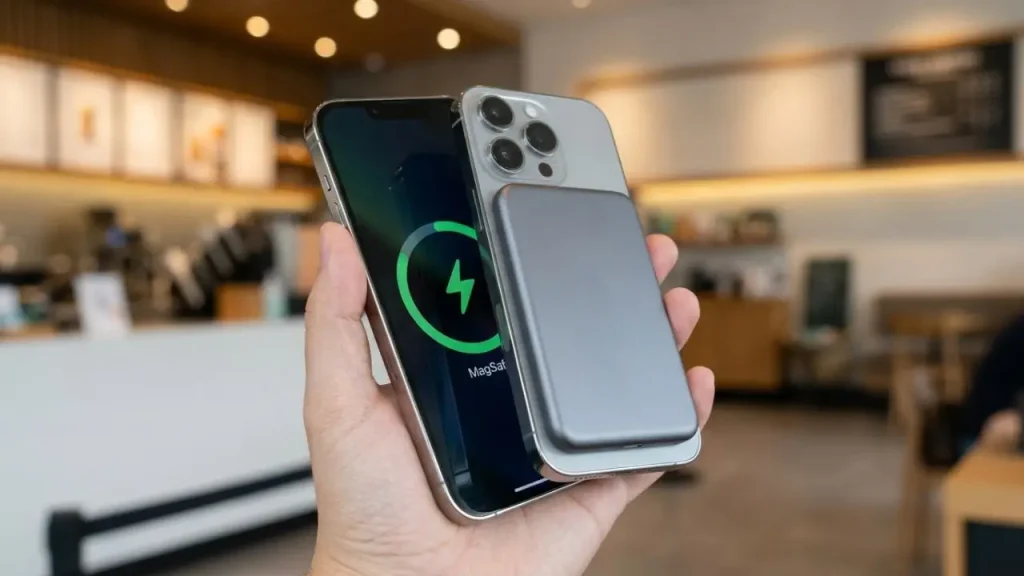
Magnetic power banks are particularly appealing to owners of compatible iPhones. They attach directly to the back of the smartphone, eliminating the need for a standard charging cable between the power bank and the iPhone. This makes them convenient to use when you want to text, navigate, or take photos at the same time.
The main advantage, therefore, isn’t necessarily that magnetic charging is inherently faster; rather, it is about convenience. A small magnetic power bank can remain attached to the iPhone while you hold the device in your hand. In contrast, a wired power bank involves a cable dangling between the smartphone and the battery pack, which can sometimes be bothersome when you are on the go.
When USB-C Is the Better Choice
A USB-C power bank is exceptionally versatile. For iPhone models equipped with USB-C, you can use a standard USB-C-to-USB-C cable. This enables a fast, straightforward connection while also reducing the number of different cables you need to carry with you.
Another advantage of USB-C is its flexibility. A suitable power bank can charge not only your iPhone but also headphones, tablets, certain cameras, and other USB-C devices. Consequently, if you regularly use multiple electronic devices, a good USB-C battery pack often offers greater utility than a purely magnetic solution.
For older iPhones with a Lightning port, however, you should check which cable is required. While the power bank itself may feature a USB-C port, the connecting cable must be compatible with the iPhone’s port. A small detail like this can determine whether the power bank is ready for use right out of the box.
Which size and capacity suit your daily routine?
The right capacity depends largely on how you use your iPhone. If you leave the house in the morning with a fully charged smartphone and only need a little extra power occasionally during the day, you generally don’t need a heavy battery pack. For such users, a smaller model is often more convenient.
A power bank with around 5,000 mAh can be a great option for an extra boost of power while on the go. It is easy to carry in a bag and takes up very little space. This size is particularly appealing for short trips or as an emergency backup.
Wenn du neben deinem iPhone auch AirPods unterwegs verwendest, kannst du unseren Vergleich [AirPods Pro 2 vs AirPods Pro 3] lesen, um die Unterschiede zwischen den beiden Modellen zu verstehen.
A 10,000 mAh power bank strikes a good balance for many users. It offers significantly more reserve power without being as bulky as extra-large models. If you regularly spend long days away from home, it can provide multiple charging cycles—or at least a substantial recharge—depending on your iPhone model and energy loss during charging.
Larger power banks make more sense for travel
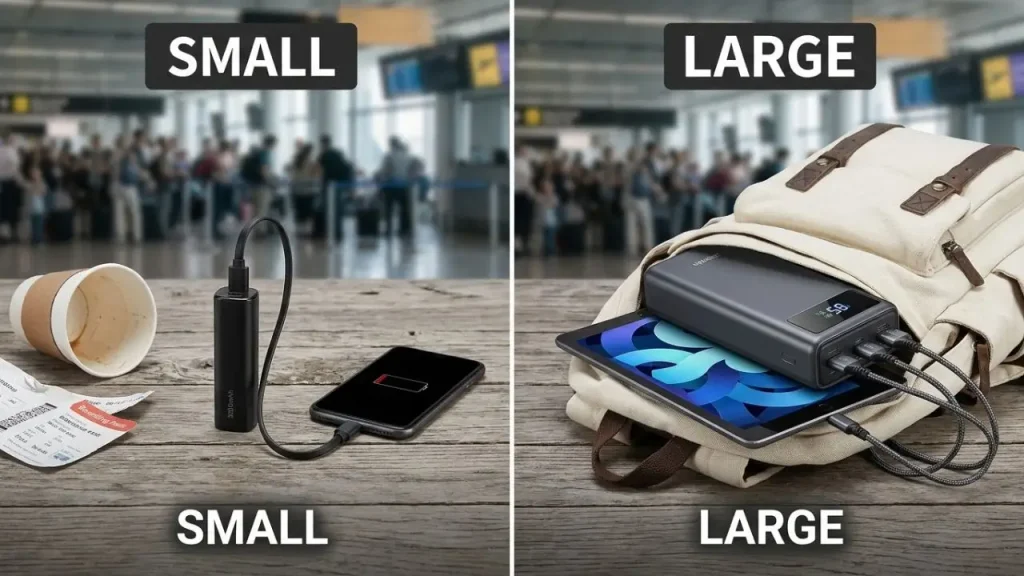
The situation is somewhat different when traveling. If you spend many hours on a train, bus, or plane and use your iPhone heavily, extra capacity can be valuable. Navigation, mobile data, the camera, streaming, and Bluetooth can drain the battery much faster than sending the occasional message or making a quick call.
A 20,000 mAh power bank therefore offers more reserve power for longer trips. However, it is usually larger and heavier. Additionally, when flying, you should observe the specific airline and airport regulations regarding power banks and lithium batteries.
So, higher capacity does not automatically mean a better choice. A power bank that stays at home because it is too heavy to carry around daily is less useful than a smaller model that actually gets taken along regularly.
Understanding Charging Speed, Ports, and Safety
Charging speed is one of the most important features of a power bank. If you want to recharge your iPhone as quickly as possible during a short break, the power bank should feature a suitable output and appropriate charging power.
Apple also explains the requirements for fast charging various iPhone models.
Models with USB-C Power Delivery—often referred to as USB-C PD—are particularly convenient. This technology enables dynamic communication between the charger and the device, allowing for the delivery of the optimal charging power. Crucially, what matters is not just the maximum wattage listed on the packaging, but also support for the relevant charging protocols.
Another factor to consider is the number of ports. If you are charging only an iPhone, you may not need a wide range of ports. However, if you want to power an iPhone, an Apple Watch, or headphones simultaneously, you can benefit from having multiple outputs.
Safety Should Never Be an Afterthought
A power bank contains a lithium battery and therefore should not be selected based solely on price or capacity. Reputable manufacturers incorporate protective mechanisms against issues such as overcharging, overheating, short circuits, and excessive discharging.
User behavior also plays a role. A power bank should not be exposed to excessive heat unnecessarily. Especially in summer, a battery pack can become very hot if left in a closed car or in direct sunlight. This can compromise both the battery’s lifespan and safety.
Damaged or swollen power banks should not be used. Likewise, one should exercise caution with extremely cheap products that lack clear manufacturer information. For an accessory that is connected daily to a high-quality smartphone, reliable build quality and safety features are more important than the lowest possible purchase price.
Which power bank is right for which iPhone user?
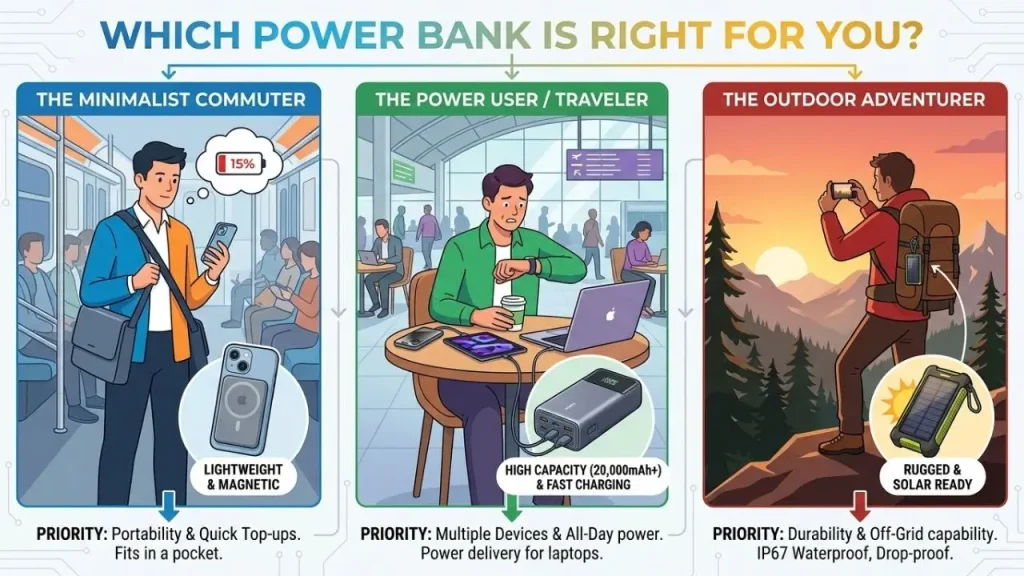
There is no single power bank that is perfect for every iPhone owner. A student who only needs a small backup charge each day has different requirements than someone who travels constantly for work. Photographers, travelers, and users of multiple devices also benefit from different features.
For daily use
For everyday life, a compact 5,000 to 10,000 mAh power bank is often sufficient. It should be light enough to carry around regularly and feature a reliable charging output.
A magnetic model can be particularly convenient if you want to keep using your compatible iPhone while it charges. However, if you want maximum flexibility, a USB-C model is often a better choice.
For travel and long days
Travelers tend to benefit more from a higher-capacity power bank. A 10,000 or 20,000 mAh model makes sense when power outlets aren’t reliably available.
It is also worth considering the number of ports. If you need to charge headphones, a tablet, or other devices alongside your iPhone, a power bank with multiple outputs can make life on the go much easier.
For users who want to travel light
If you want to minimize weight and bulk, you shouldn’t automatically opt for the highest capacity available. A small power bank can be perfectly adequate as an emergency backup.
Especially for short trips, the balance between size, weight, and available energy matters more than an impressive number on the packaging. A good power bank should fit your daily routine, not the other way around.
What should you look for when buying an iPhone power bank?
It pays to run through a quick checklist before buying. First, determine which port your iPhone has. Then, decide whether you prefer charging via a cable or using a magnetic connection. Next, consider capacity, charging speed, size, and weight.
Included accessories can also be important. A good cable can make the difference between a hassle-free charging experience and the need to buy extra accessories. For USB-C devices, make sure to choose a cable that supports the desired charging speed.
Price shouldn’t be viewed in isolation, either. A high-quality power bank might seem more expensive at first, but it may offer better safety features, more durable components, and more reliable charging electronics. Build quality can make a significant difference, especially for a product that is frequently charged and carried around.
Finding the Right Balance
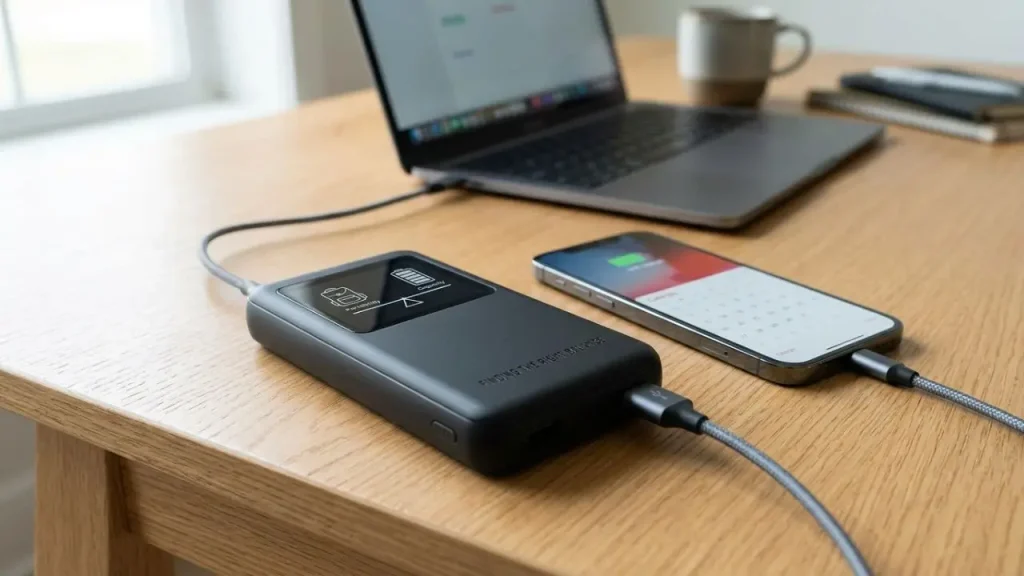
The ideal choice is easiest to find when you consider your actual needs. If you only need to recharge occasionally, a lightweight power bank is likely more practical than a large battery pack. However, if you travel frequently, extra capacity might be more important.
You should also consider how you use the device while charging. A magnetic power bank can be very convenient in this regard, whereas a wired USB-C power bank often offers greater flexibility and potentially a faster charging connection.
Ultimately, the best power bank for an iPhone isn’t necessarily the model with the highest technical specifications. It is the power bank whose capacity, charging method, size, and performance align with your personal usage habits.
Conclusion
The search for the best power bank for your iPhone shouldn’t begin and end with the mAh rating. A good power bank needs to strike the right balance between several key features: sufficient capacity, reliable charging performance, the right ports, safe electronics, and a size that remains convenient for everyday use.
For short outings, a compact 5,000 mAh power bank may be perfectly adequate. A 10,000 mAh model offers a good compromise for many daily situations, while capacities of 20,000 mAh or higher are particularly appealing for long trips or when charging multiple devices. Magnetic charging offers convenience, whereas USB-C provides great versatility.
So, before you buy, take a moment to consider where and how you usually charge your iPhone. The right power bank isn’t necessarily the one with the biggest numbers on the box, but the one that reliably delivers extra power exactly when you need it.
Frequently Asked Questions
1. What capacity should a power bank for an iPhone have?
For daily use, 5,000 to 10,000 mAh is often sufficient. If you are out and about for long periods or want to charge multiple devices, a 20,000 mAh model offers significantly more reserve power. However, the actual number of charges depends on various factors and energy losses.
2. Is a magnetic power bank better than a USB-C power bank?
That depends on your personal needs. Magnetic power banks offer great convenience because they attach directly to a compatible iPhone. USB-C power banks, on the other hand, are highly versatile and can charge various devices via a cable.
3. Can a power bank fast-charge an iPhone?
Yes, a suitable power bank can charge an iPhone at high speeds. To achieve this, the power bank, cable, and iPhone must all be compatible with one another. Also, a higher maximum wattage rating on the power bank does not automatically mean the iPhone will utilize that full power output.
4. Is 20,000 mAh too much for an iPhone?
Not necessarily. A 20,000 mAh power bank can be very practical for travel, long workdays, or charging multiple devices. However, for short trips, it is often bulkier and heavier than necessary.
5. What should I look for regarding power bank safety?
Look for a reputable manufacturer, high-quality construction, and built-in safety features to protect against overcharging, overheating, and short circuits. You should not continue using a power bank that is damaged or swollen.
