

Introduction
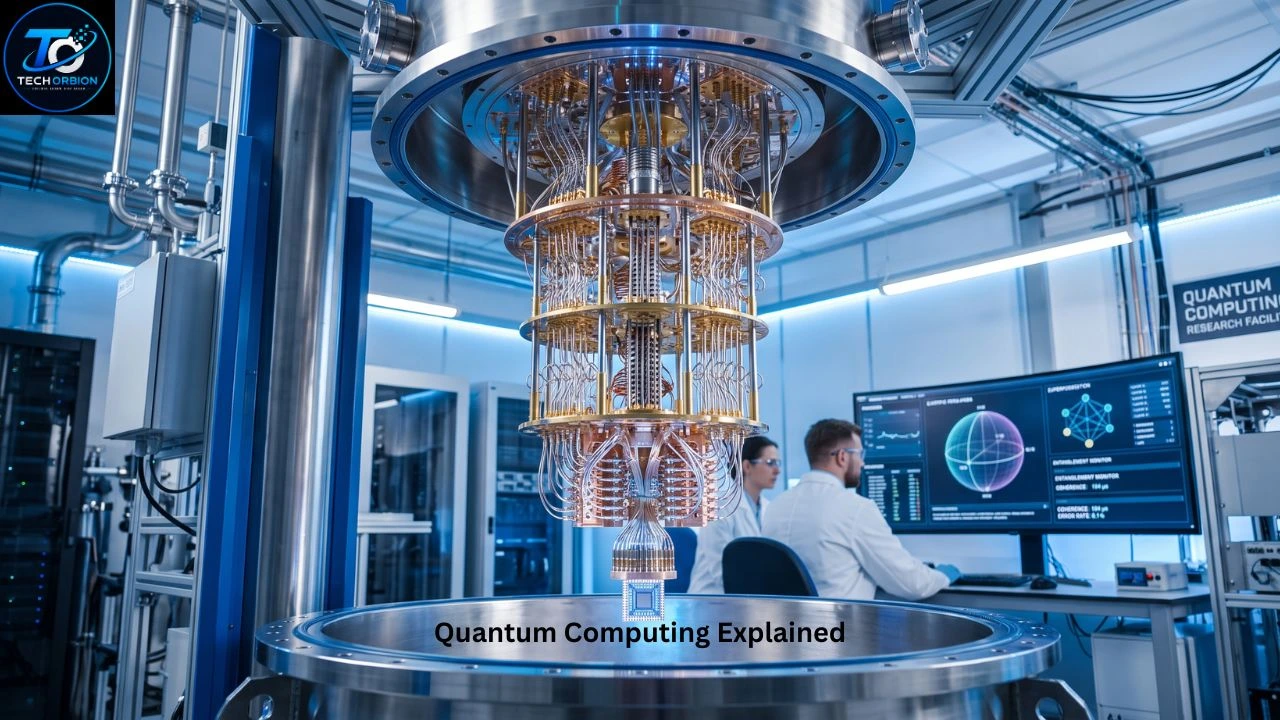
Quantum Computing is an advanced field of computer science that uses the principles of quantum mechanics to solve problems far beyond the capabilities of traditional computers. Unlike classical computers that process information as bits, quantum computers use qubits, allowing them to perform multiple calculations simultaneously. This technology has the potential to transform industries such as healthcare, finance, cybersecurity, and artificial intelligence by solving complex calculations much faster.
Although still in its early stages, quantum computing is rapidly advancing through research and innovation by leading technology companies and universities. As quantum systems become more practical, they are expected to revolutionize scientific discovery, data processing, and real-world problem-solving, making quantum computing one of the most exciting technologies shaping the future.
Read our World Quantum Day guide to learn about the global celebration of quantum science.
Table of Contents
- What Is Quantum Computing?
- How Does Quantum Computing Work?
- History of Quantum Computing
- Key Features of Quantum Computing
- Real-Life Applications
- Benefits of Quantum Computing
- Challenges and Limitations
- Future Trends
- Frequently Asked Questions
- Conclusion
What Is Quantum Computing?
Quantum Computing is a new type of computing that uses the principles of quantum physics to process information. Unlike traditional computers, which use bits that can only be either 0 or 1, quantum computers use qubits. A qubit can represent multiple states at the same time, making it possible to perform certain calculations much faster.
This technology is designed to solve highly complex problems that are difficult or even impossible for traditional computers. It is not meant to replace everyday computers but to work alongside them for specialized tasks such as scientific research, data analysis, and advanced simulations.
Many leading technology companies, universities, and research organizations are developing quantum computers. Although the technology is still in its early stages, experts believe it will play an important role in the future of computing.
How Does Quantum Computing Work?
Quantum Computing works by using qubits instead of regular bits. Traditional computers process information one step at a time using binary values of 0 and 1. In contrast, qubits can exist in multiple states at the same time through a property called superposition. This allows quantum computers to explore many possible solutions simultaneously.
Another important concept is entanglement. When qubits become entangled, they remain connected even when separated by a distance. This connection helps quantum computers process information more efficiently than traditional systems in certain situations.
Imagine trying to find the fastest route through thousands of cities. A traditional computer may check many routes one after another. A quantum computer can evaluate many possibilities at the same time, making it much faster for certain complex problems. This unique ability is why Quantum Computing is considered one of the most promising technologies for the future.
Continue reading our [Data Science] guide for more detailed information.
History of Quantum Computing
The idea of Quantum Computing began in the early 1980s when scientists started exploring whether the laws of quantum physics could be used to build a new kind of computer. They believed that some problems were too difficult for traditional computers but could be solved more efficiently by quantum machines.
Over the years, researchers developed new theories and experimental quantum systems. As technology improved, universities, research labs, and leading technology companies invested heavily in quantum research. Today, quantum computers are still developing, but they are becoming more powerful every year.
Although Quantum Computing is not yet ready for everyday personal use, it has already shown promising results in scientific research, medicine, cybersecurity, and artificial intelligence. Experts expect the technology to continue advancing in the coming decades.
Key Features of Quantum Computing
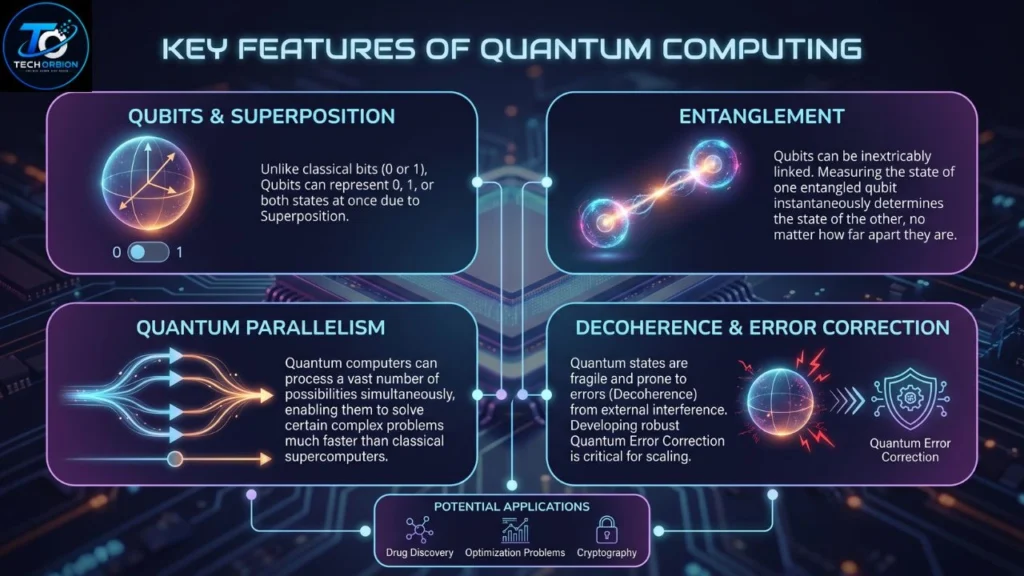
Quantum Computing has several unique features that make it different from traditional computing.
Uses Qubits Instead of Bits
Traditional computers use bits that can only be 0 or 1. Quantum computers use qubits, which can exist in multiple states at the same time. This allows them to process information much more efficiently for certain tasks.
Superposition
Superposition enables a qubit to represent multiple possibilities at once. Instead of checking one answer after another, a quantum computer can evaluate many possibilities simultaneously. This greatly improves performance for specific complex calculations.
Entanglement
Entanglement is a special connection between qubits. When qubits become entangled, changes to one qubit are linked with the other, allowing them to work together efficiently. This improves the speed and accuracy of quantum calculations.
Quantum Parallelism
Quantum computers can process many possible solutions at the same time. This makes them especially useful for optimization problems, scientific simulations, and advanced data analysis.
High-Speed Problem Solving
For certain types of problems, quantum computers can perform calculations much faster than traditional computers. This could lead to major breakthroughs in healthcare, finance, logistics, and scientific research.
Real-Life Applications of Quantum Computing
Although Quantum Computing is still developing, it is already being tested in several industries.
In healthcare, researchers use quantum computing to study complex molecules and support faster drug discovery. This may help scientists develop better medicines and treatments in the future.
In cybersecurity, quantum technology is helping researchers develop stronger encryption methods that can better protect sensitive information from cyber threats.
The finance industry is exploring quantum computing to improve risk analysis, detect fraud, and optimize investment strategies. Faster calculations can help financial institutions make better decisions.
Scientists also use quantum computers for climate research, where they analyze large amounts of environmental data to improve weather forecasting and better understand climate change.
As the technology continues to improve, Quantum Computing is expected to support advances in artificial intelligence, transportation, manufacturing, energy, and many other fields.
Benefits of Quantum Computing
Quantum Computing has the potential to transform many industries by solving problems that are difficult for traditional computers. While the technology is still developing, its future benefits are already attracting global attention.
Faster Problem Solving
Quantum computers can perform certain calculations much faster than classical computers. This speed can help scientists, researchers, and businesses solve complex problems in less time.
Better Medical Research
Healthcare researchers can use quantum computing to study complex molecules and simulate chemical reactions. This may lead to faster drug discovery, improved treatments, and more personalized healthcare.
Stronger Cybersecurity
Quantum technology is helping experts develop advanced encryption methods to better protect sensitive information. Secure communication systems may become more reliable as quantum research continues.
Smarter Artificial Intelligence
Artificial intelligence systems require large amounts of data processing. Quantum Computing could improve machine learning by analyzing data more efficiently and helping AI models make better predictions.
Improved Business Decisions
Companies can use quantum computers to optimize supply chains, reduce costs, improve delivery routes, and analyze business risks more effectively. This can save both time and resources.
Scientific Innovation
Researchers can solve difficult scientific problems, simulate natural processes, and develop new materials much faster than before. This could accelerate discoveries in chemistry, physics, and engineering.
Challenges and Limitations
Despite its exciting potential, Quantum Computing also faces several important challenges.
Expensive Technology
Quantum computers are very costly to build and maintain. They require specialized hardware and advanced research facilities, making them unavailable to most individuals and small businesses.
Sensitive Environment
Qubits are extremely delicate and can easily lose their quantum state because of heat, vibration, or electrical noise. Most quantum computers must operate at temperatures close to absolute zero to function correctly.
Error Rates
Quantum systems are more likely to produce errors than traditional computers. Researchers are working on quantum error correction, but this remains one of the biggest challenges in the field.
Limited Practical Use
Today’s quantum computers are designed for specific research and business applications. They cannot yet replace personal computers for everyday activities such as browsing the internet, writing documents, or playing games.
Skilled Professionals Are Needed
Quantum Computing combines physics, mathematics, computer science, and engineering. As the industry grows, there is an increasing need for trained professionals with specialized knowledge.
Best Practices for Learning Quantum Computing
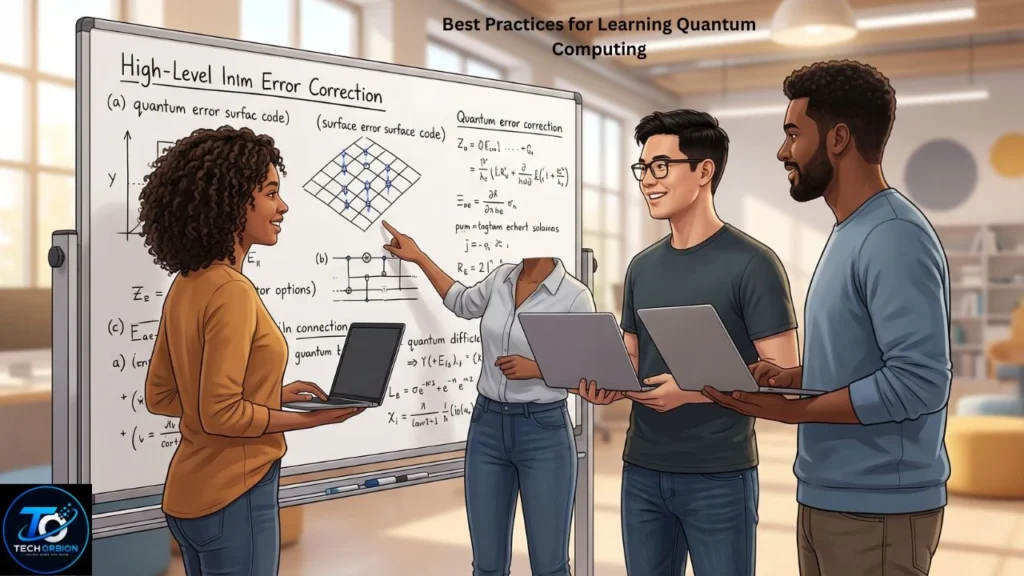
Learning Quantum Computing may seem difficult at first, but a step-by-step approach makes it much easier.
To learn more about real-world quantum computing, visit IBM Quantum, where you can explore quantum hardware, Qiskit, and cloud-based quantum services.
- Learn the basics of computers before studying quantum concepts.
- Build a simple understanding of physics and mathematics.
- Focus on key ideas such as qubits, superposition, and entanglement.
- Practice consistently instead of trying to learn everything at once.
- Stay updated with new developments because the field is evolving rapidly.
- Be patient, as Quantum Computing is an advanced topic that takes time to understand.
With regular learning and curiosity, even beginners can develop a strong foundation in Quantum Computing and prepare for future opportunities in technology.
Future Trends of Quantum Computing
Quantum Computing is advancing rapidly, and experts believe it will become one of the most important technologies of the future. Although it is still in its early stages, researchers continue to improve the speed, stability, and reliability of quantum computers.
More Powerful Quantum Computers
Future quantum computers are expected to contain more stable qubits and perform calculations with fewer errors. This will allow them to solve larger and more complex problems than today’s systems.
Better Artificial Intelligence
Quantum Computing could make artificial intelligence smarter and faster. AI systems may process huge amounts of data more efficiently, leading to better predictions, improved automation, and more accurate decision-making.
Advances in Healthcare
Scientists expect quantum technology to speed up medical research by helping discover new medicines, study diseases, and create personalized treatments based on individual patient needs.
Stronger Digital Security
As cyber threats continue to grow, quantum technology may improve encryption methods and create more secure communication systems. At the same time, researchers are developing new security standards to prepare for the future of quantum computing.
Business and Industry Growth
Many industries, including finance, manufacturing, transportation, and energy, are investing in quantum research. In the coming years, businesses may use quantum computers to optimize operations, reduce costs, and solve problems more efficiently.
Who Should Learn Quantum Computing?
Quantum Computing is not only for scientists. Many people can benefit from understanding its basic concepts.
- Students who want a career in technology, engineering, or science.
- Software developers interested in next-generation computing.
- Cybersecurity professionals preparing for future encryption methods.
- Artificial intelligence engineers looking to improve machine learning systems.
- Researchers working in healthcare, chemistry, physics, or mathematics.
- Business leaders who want to understand how quantum technology may affect their industries.
Even beginners with no background in quantum physics can start by learning the fundamentals and gradually build their knowledge.
Quantum Computing vs Classical Computing
| Feature | Quantum Computing | Classical Computing |
|---|---|---|
| Data Unit | Qubits | Bits |
| Processing | Multiple possibilities at once | One calculation at a time |
| Speed | Faster for specific complex tasks | Better for everyday computing |
| Best For | Research, simulations, optimization | Daily computing tasks |
| Current Availability | Limited and experimental | Widely available |
Both technologies have important roles. Quantum computers are designed to solve specialized problems, while classical computers remain the best choice for everyday activities such as web browsing, gaming, office work, and communication.
Benefits of Quantum Computing
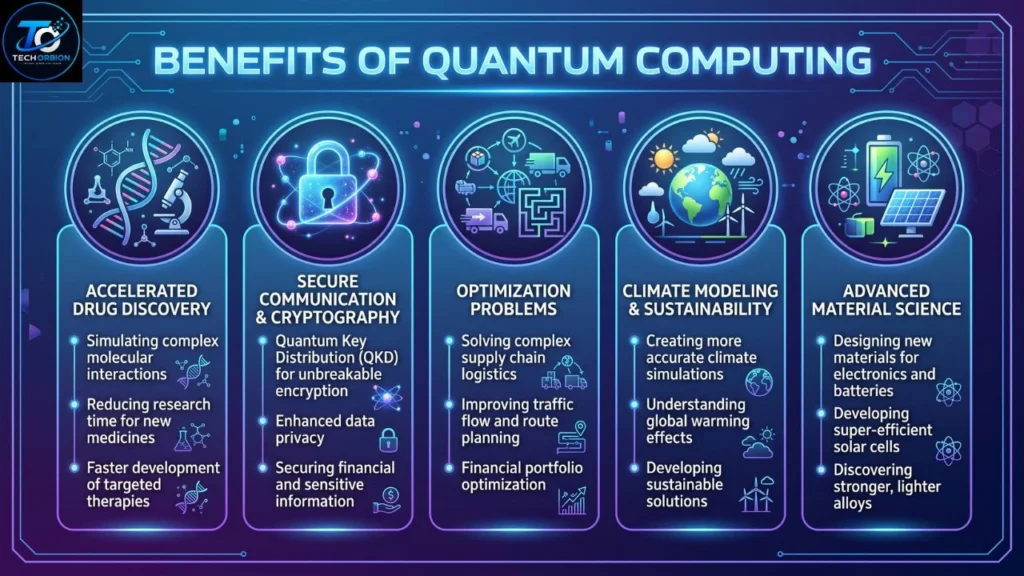
Quantum Computing offers many advantages that could change the way we solve complex problems. As the technology continues to improve, these benefits are expected to become even more valuable across different industries.
- Solves complex calculations much faster than traditional computers.
- Supports faster scientific research and innovation.
- Helps discover new medicines and improve healthcare.
- Improves cybersecurity through advanced encryption techniques.
- Enhances artificial intelligence and machine learning.
- Optimizes business operations and supply chains.
- Improves weather forecasting and climate research.
- Helps financial institutions analyze risks more accurately.
- Encourages innovation in science and technology.
- Opens new career opportunities in emerging technology fields.
Common Mistakes About Quantum Computing
Many beginners misunderstand Quantum Computing. Avoiding these common mistakes can make learning much easier.
Thinking Quantum Computers Will Replace All Computers
Quantum computers are designed for specialized tasks. They will work alongside classical computers rather than replace them.
Believing Quantum Computing Is Magic
Quantum Computing is based on the proven laws of quantum physics. Although it seems amazing, it is real science—not science fiction.
Ignoring the Basics
Many people jump into advanced topics too quickly. Learning the fundamentals of computers, mathematics, and quantum physics first makes the subject much easier.
Expecting Instant Results
Quantum technology is still developing. Many practical applications are being researched and may take years to become widely available.
Assuming Anyone Can Build a Quantum Computer
Building a quantum computer requires advanced knowledge, specialized equipment, and years of scientific research. It is far more complex than assembling a regular computer.
Frequently Asked Questions
1. What is Quantum Computing?
Quantum Computing is a new type of computing that uses the principles of quantum physics to process information. Instead of using bits like traditional computers, it uses qubits, which can represent multiple states at the same time. This allows quantum computers to solve certain complex problems much faster than classical computers.
2. How is Quantum Computing different from classical computing?
Classical computers process information using bits that are either 0 or 1. Quantum computers use qubits, which can exist in multiple states simultaneously. This unique ability allows them to perform many calculations at once, making them more suitable for specific scientific and mathematical problems.
3. What are the real-world applications of Quantum Computing?
Quantum Computing has applications in healthcare, artificial intelligence, cybersecurity, finance, logistics, climate research, and material science. Researchers use it to develop new medicines, improve data security, optimize transportation systems, and solve complex scientific challenges.
4. Can beginners learn Quantum Computing?
Yes. Beginners can start by learning basic computer science, mathematics, and simple quantum concepts. Many educational resources explain topics like qubits, superposition, and entanglement in easy-to-understand language before moving to advanced subjects.
5. Is Quantum Computing the future of technology?
Quantum Computing is expected to become one of the most important technologies of the future. While it will not replace traditional computers, it has the potential to transform industries by solving problems that are currently beyond the capabilities of classical computing.
Conclusion
Quantum Computing is changing the future of technology by introducing a new way to solve complex problems. Unlike traditional computers, quantum computers use qubits and the principles of quantum physics to perform specialized calculations more efficiently. Although the technology is still developing, it has already shown great promise in healthcare, cybersecurity, artificial intelligence, finance, and scientific research.
As more organizations invest in quantum research, new discoveries and practical applications are expected to emerge. Learning the basics of Quantum Computing today can help students, professionals, and technology enthusiasts prepare for the future. Whether you are simply curious about emerging technologies or planning a career in technology, understanding Quantum Computing is a valuable step toward staying informed in a rapidly evolving digital world.
