

Machine learning is no longer just a futuristic concept—it is already part of our daily lives. From Netflix recommendations to Google search results and self-driving cars, machine learning is quietly shaping the modern world.
If you are completely new to this field, don’t worry. This guide on Machine learning basics will help you understand everything step by step in simple English, without confusing technical jargon.
You can also read our guide on : Machine Learning Algorithms Python
What Are Machine Learning Basics?
To understand Machine learning basics, we first need to understand what machine learning actually means.
Machine learning is a branch of artificial intelligence (AI) that allows computers to learn from data and improve their performance without being explicitly programmed.
Simple Explanation:
Instead of writing fixed instructions for a computer, we give it data and let it learn patterns automatically.
👉 Example:
- Email spam filter learns which emails are spam
- Netflix learns what movies you like
- Google Maps learns traffic patterns
Why Understanding Machine Learning Basics Is Important
In today’s digital world, machine learning is everywhere.
Key reasons to learn it:
- High demand in tech jobs
- Used in almost every industry
- Powers AI applications
- Helps in data-driven decision making
👉 Learning Machine learning basics gives you a strong foundation for future tech skills.
How Machine Learning Works (Simple Breakdown)
To understand Machine learning basics, you need to know the process.
Step 1: Data Collection
Machines need data to learn.
- Images
- Text
- Numbers
- Videos
Step 2: Training the Model
The system studies data to find patterns.
👉 Example:
If you show 1000 cat pictures, the system learns what a cat looks like.
Step 3: Prediction
Finally, the model makes predictions on unseen data.
Types of Machine Learning in Machine Learning Basics
There are three main types.
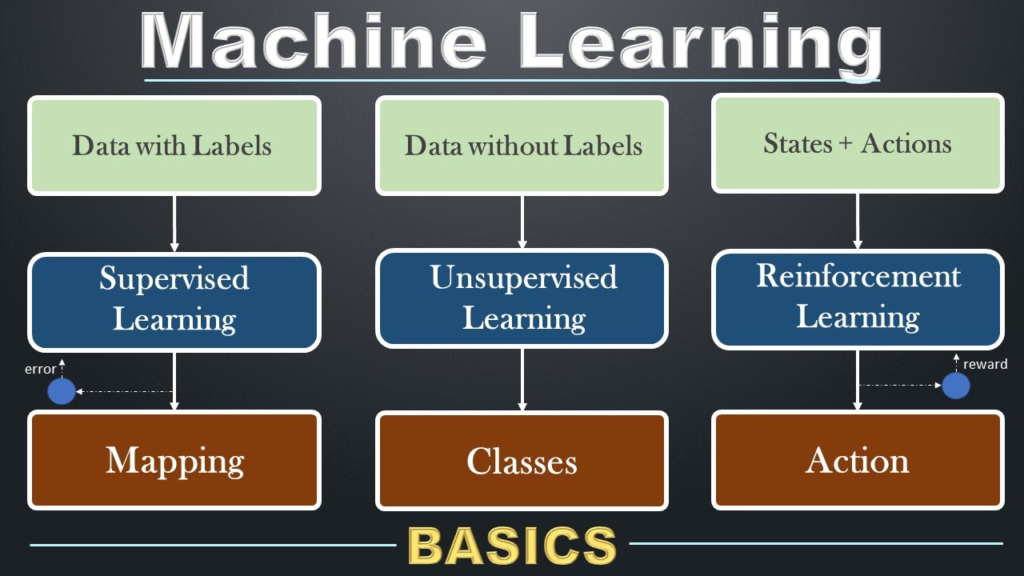
1. Supervised Learning
In this type, the model is trained with labeled data.
Example:
- Input: Email
- Output: Spam or Not Spam
👉 The system already knows the correct answers.
2. Unsupervised Learning
Here, the data is not labeled.
Example:
- Grouping customers based on behavior
- Finding hidden patterns
👉 The system discovers structure on its own.
3. Reinforcement Learning
This is learning through rewards and penalties.
Example:
- Self-driving cars
- Game AI
👉 The system learns by trial and error.
Key Components of Machine Learning Basics
To fully understand Machine learning basics, you must know its components.
1. Data
Data is the most important part.
- Without data, no learning happens
2. Algorithms
Algorithms are mathematical rules used for learning.
3. Model
A model is the final trained system.
4. Features
Features are input variables used for learning.
Real-Life Applications of Machine Learning Basics
Machine learning is everywhere in real life.
1. Social Media
- Facebook friend suggestions
- Instagram feed personalization
2. E-commerce
- Product recommendations on Amazon
- Personalized shopping experience
3. Healthcare
- Disease prediction
- Medical image analysis
4. Finance
- Fraud detection
- Credit scoring
5. Entertainment
- Netflix recommendations
- YouTube video suggestions
Machine Learning Basics vs Traditional Programming
Understanding the difference is important.
Traditional Programming:
- Rules are fixed
- Input + logic = output
Machine Learning:
- Data + output = rules (learned automatically)
👉 Machine learning is more flexible and adaptive.
Common Challenges in Machine Learning Basics
While learning Machine learning basics, beginners face some challenges.
1. Data Quality Issues
Bad data leads to bad results.
2. Underfitting
Model is too simple to learn patterns.
3. Lack of Experience
Practice is necessary to improve skills.
Tools Used in Machine Learning Basics
To work in machine learning, you need tools.
Popular tools:
- Python
- Jupyter Notebook
- TensorFlow
- Scikit-learn
- Pandas
- NumPy
👉 Python is the most widely used language.
Why Python Is Important in Machine Learning Basics
Python is beginner-friendly and powerful.
Reasons:
- Simple syntax
- Large community support
- Many ML libraries
- Easy integration
👉 That’s why most learners start with Python.
Step-by-Step Learning Path for Machine Learning Basics
If you are a beginner, follow this roadmap:
Step 1: Learn Python
Understand basics like variables, loops, and functions.
Step 2: Learn Math Basics
- Linear algebra
- Probability
- Statistics
Step 3: Understand Data Handling
Use Pandas and NumPy.
Step 4: Learn Algorithms
- Linear regression
- Decision trees
- KNN
Step 5: Practice Projects
- Spam detection
- House price prediction
Simple Example of Machine Learning in Real Life
Input Data:
- Size of house
- Location
- Number of rooms
Output:
- Price of house
👉 The model learns from past data and predicts future prices.
Future of Machine Learning Basics
Machine learning is growing rapidly.
Future trends:
- AI automation
- Self-driving technology
- Smart assistants
- Advanced robotics
👉 Demand will continue increasing.
Tips for Learning Machine Learning Basics Effectively
1. Start Simple
Don’t jump into advanced topics.
2. Practice Daily
Consistency is key.
3. Build Projects
Real-world practice improves understanding.
4. Learn by Doing
Theory alone is not enough.
Common Mistakes Beginners Should Avoid
❌ Skipping basics
❌ Ignoring math
❌ Not practicing coding
❌ Copy-paste learning
👉 Focus on understanding, not memorizing.
Final Thoughts on Machine Learning Basics
Learning Machine learning basics is one of the best decisions for anyone interested in technology and future careers.
It may look complex at first, but with step-by-step learning, it becomes much easier to understand. The key is consistency, practice, and curiosity.
Machine learning is not just a skill—it is a gateway to the future of technology.
Quick Summary
- Machine learning is about learning from data
- It has 3 main types: supervised, unsupervised, reinforcement
- Python is the most important tool
- Real-world applications are everywhere
- Practice is essential for mastery
