

Introduction
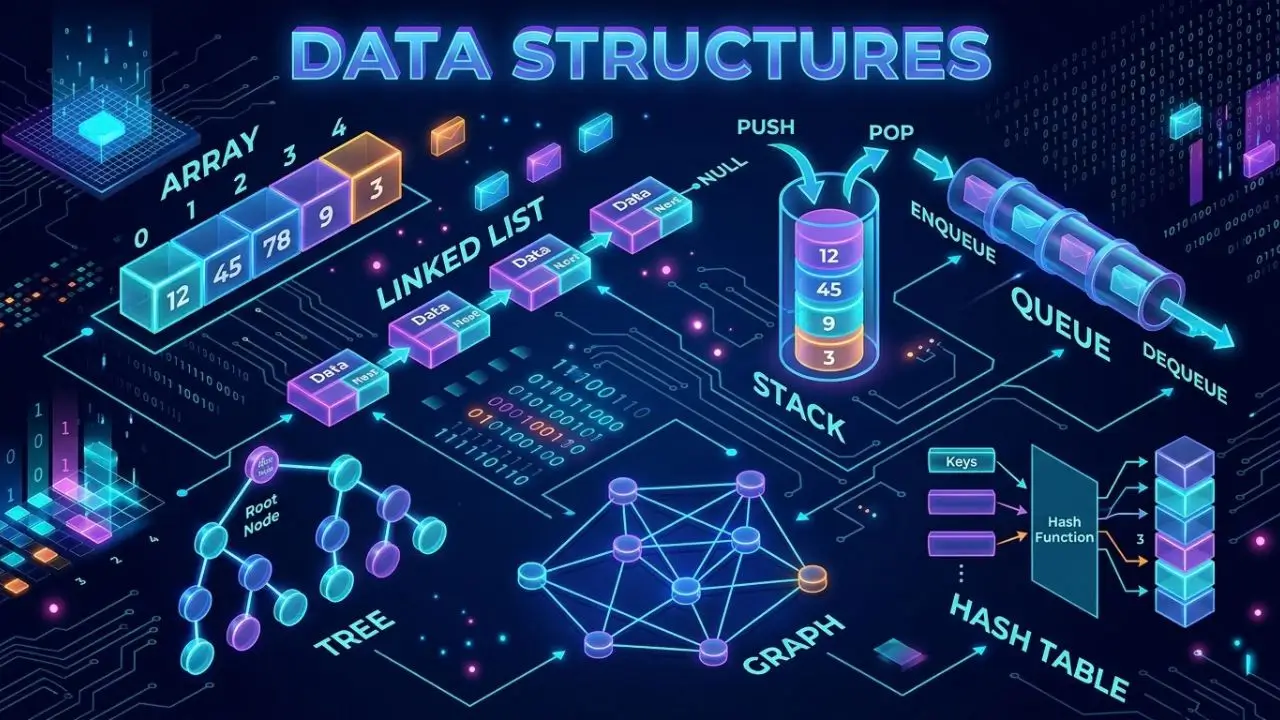
Programs constantly work with data. Names, numbers, user accounts, product lists, messages, and search results all need to be stored, modified, and retrieved. However, simply stashing data somewhere isn’t enough; the way information is organized significantly impacts a program’s speed and reliability. This is precisely where data structures come into play.
A data structure describes a specific method for organizing and managing data in memory. Depending on the task, one structure may be better suited than another. A simple list might be perfectly adequate for a small number of values, whereas a large application might require a tree, a hash table, or a graph. Understanding data structures, therefore, involves more than just learning individual programming concepts; it fosters a better grasp of how software functions behind the scenes.
Anyone who understands data structures therefore not only learns about individual programming concepts but also develops a better sense of how software works behind the scenes.
Data structures are a fundamental topic in computer science. Developers encounter them when working with databases, search functions, operating systems, games, mobile apps, and many other types of software. In this guide, we will examine the most important types of data structures, explain how they work, and show when it makes sense to use each one.
1. What are data structures and why are they important?
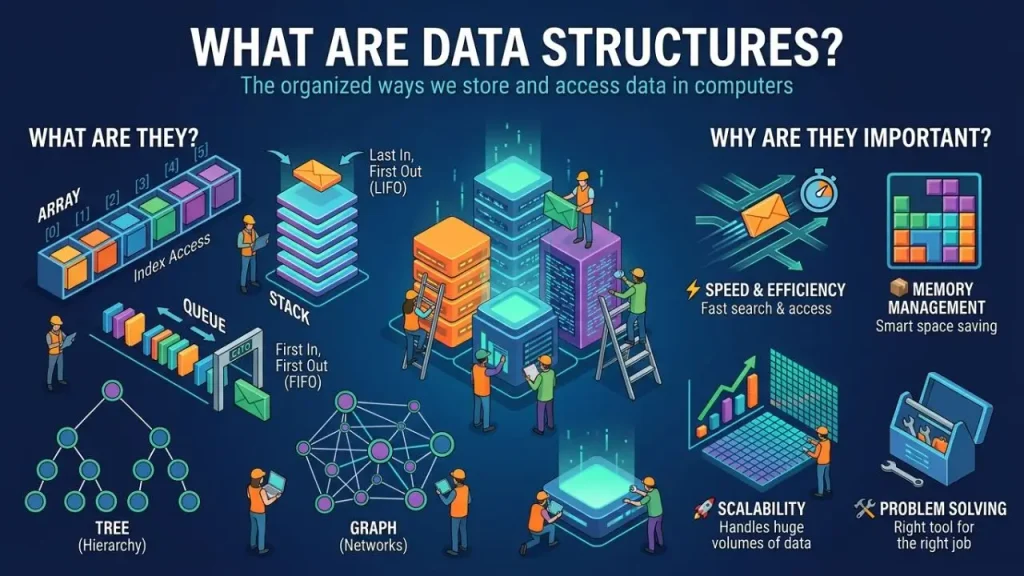
Simply put, a data structure is an organized way of storing data. Consider a shopping list, for example: the products could simply be written down one after another. In a program, this list might be stored as an array or a list. Conversely, if you wanted to represent relationships between different people, a different structure—such as a graph—would be more appropriate.
The crucial point is that different tasks require different forms of data organization. If a program frequently needs to search for specific information, the data structure used should facilitate fast searches. If, on the other hand, new elements are constantly being added or removed, a structure that efficiently supports such changes might be preferable.
Data structures are therefore closely linked to a program’s performance. An unfavorable structure can cause simple tasks to become very slow when dealing with large volumes of data. Conversely, a well-chosen structure can perform the same task much more efficiently. Developers must therefore consider not only what data is to be stored, but also how that data will be used later.
Data Structures and Algorithms
Data structures and algorithms are often considered together. An algorithm describes how a task is performed, while the data structure determines how the necessary data is organized.
For instance, a search algorithm operates differently depending on whether the data is in an unordered list or stored in a sorted tree. Thus, the choice of data structure can influence which algorithm is appropriate and how efficient the overall solution is.
2. Arrays, Lists, and Linked Lists
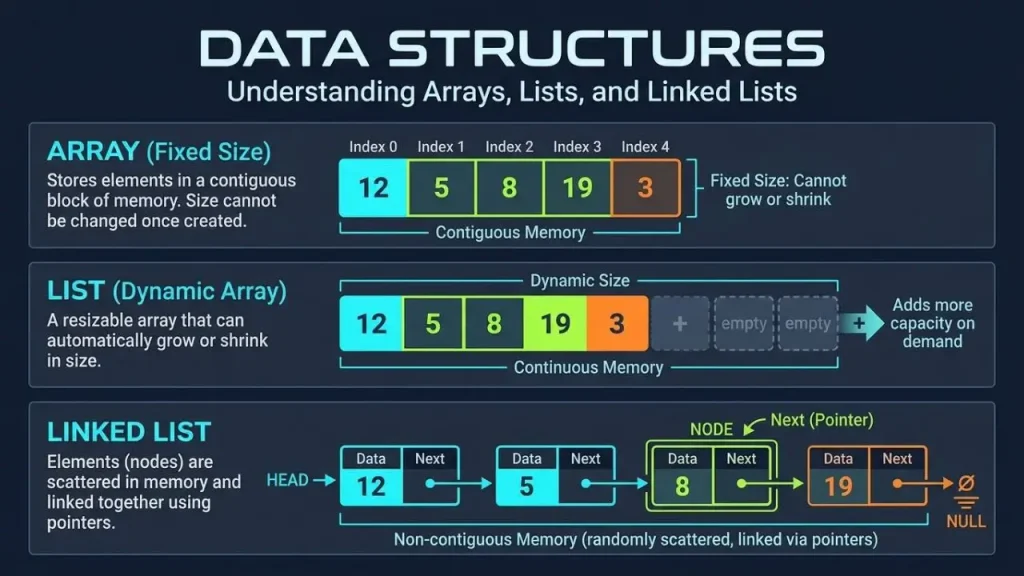
The array is one of the most well-known data structures. An array stores multiple values in a specific order. In many programming languages, elements can be accessed via an index. If an array contains five values, for example, a program can access the first, second, or fifth value based on its position.
Arrays are particularly useful when the number of elements is known or relatively stable, and when there is a need for frequent direct access to specific positions. An example would be an application that stores temperatures for seven days. If the program needs to retrieve the temperature for the third day, it can access the corresponding position directly.
A linked list works somewhat differently. Here, the structure consists of individual elements that are connected to one another. In addition to the actual data, each element contains a reference to the next element. This makes it easier to insert or remove elements without having to reorganize the entire structure.
Array or Linked List?
Both structures have their own strengths. Arrays are particularly well-suited for fast access based on position. Linked lists, on the other hand, can be advantageous when elements are frequently inserted or removed.
Therefore, the decision shouldn’t be based on the idea that one structure is inherently better than the other; the specific task is what matters. If a program primarily needs to read data at specific positions, an array can be very practical. If the number of elements changes constantly and insertion or deletion operations are the focus, a linked structure might be more suitable.
Modern programming languages also often offer more flexible list structures that employ various internal techniques. It is therefore worthwhile not only to learn the names of data structures but also to understand which operations they support particularly well.
Arrays are particularly useful when the number of elements is known or relatively stable and there is a frequent need to access specific positions directly. Those wishing to see practical examples of lists, sets, and dictionaries will find a detailed reference in the Python documentation on data structures.
3. Stacks and Queues: Processing Data According to Rules
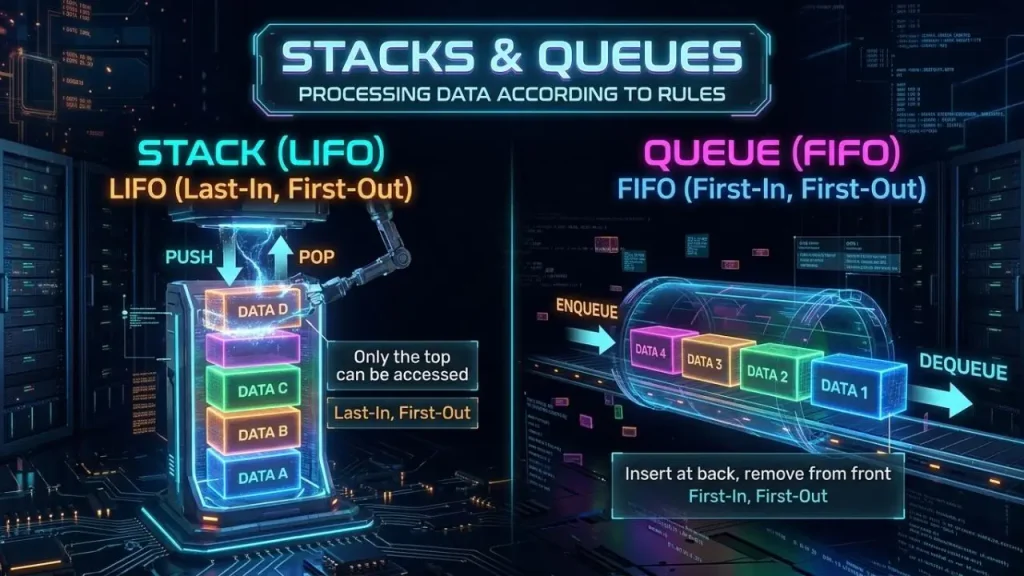
A stack is a data structure that operates on the LIFO principle. LIFO stands for “Last In, First Out,” meaning the last element added is the first one removed. A stack of books serves as a good analogy: when several books are stacked on top of one another, you typically remove the top book first.
Stacks typically feature two key operations: “push,” which places a new element onto the stack, and “pop,” which removes the top element. Additionally, a “peek” or “top” operation can be used to view the top element without removing it.
Stacks play a more significant role in software development than might appear at first glance. For instance, they are used to manage function calls, handle “undo” actions, and facilitate certain search algorithms. The familiar “back” function found in many applications can also be conceptually explained using the stack principle.
Queues Work Differently
A queue, on the other hand, follows the FIFO principle—”First In, First Out.” The element that enters the queue first is processed first. This is similar to a standard line at a checkout counter.
Queues are useful when tasks need to be processed in the order they are received. For instance, a printer might receive multiple print jobs. These jobs are collected in a queue and then processed one by one.
The difference between a stack and a queue is simple but crucial: in a stack, the most recently added element is processed first, whereas in a queue, the first element added is processed first. Which structure makes sense depends on the order required by the application.
4. Trees and Graphs: Representing Complex Relationships
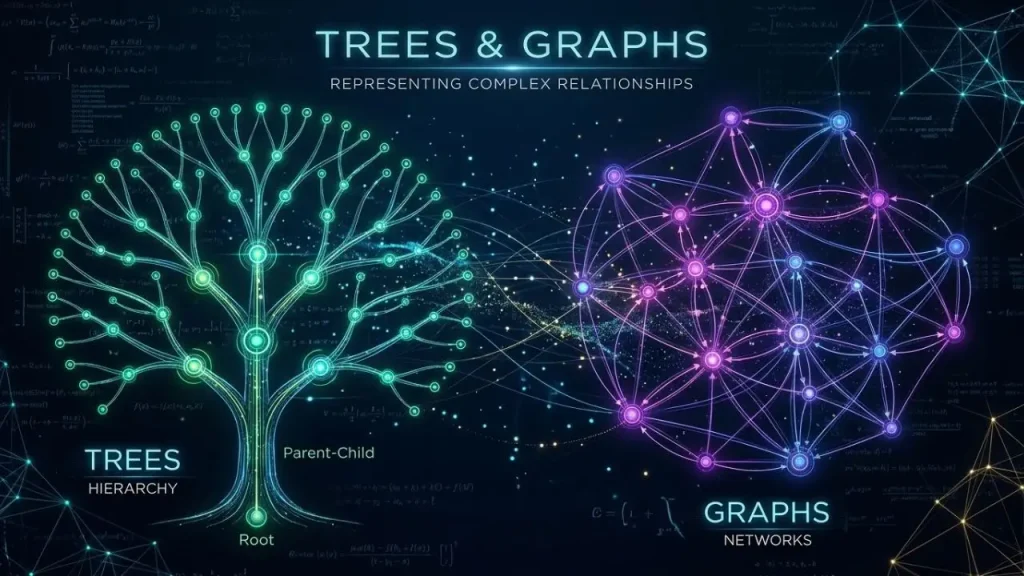
Trees are frequently used when data is organized hierarchically. A tree consists of interconnected nodes. At the very top, there is typically a “root node.” Below it, there may be other nodes, which in turn have their own subordinate nodes.
An everyday example is a computer’s folder structure. A main folder can contain several subfolders, and these subfolders can, in turn, contain further folders. This exact type of hierarchical relationship can be represented using a tree.
There are various types of trees. A binary tree, for example, has at most two subordinate nodes per node. Specialized variants, such as binary search trees, can be structured to allow for more efficient search operations. Even more sophisticated tree structures are used in database systems, for instance, when managing large volumes of information.
Graphs Represent Relationships
A graph is particularly useful when data is not simply arranged hierarchically but involves complex interrelationships. A graph consists of nodes and the connections between them.
A social network, for example, can be represented as a graph. Individuals can be viewed as nodes, while friendships or other relationships represent the connections. Road maps, flight connections, and networks can also be modeled using graphs.
Graphs can be directed or undirected. In a directed graph, a connection has a specific direction; this is useful, for example, in a social network featuring one-way “follows.” In an undirected graph, by contrast, the relationship exists in both directions.
The strength of graphs lies in their ability to represent real-world relationships with great flexibility. Consequently, they form a crucial foundation for many applications that require analyzing not just individual values, but the connections between them.
5. Hash Tables and Choosing the Right Data Structure

A hash table is a data structure designed specifically for fast access via keys. Instead of simply searching for a value based on its position, a key is used. A so-called hash function calculates a position from this key where the associated information can be stored or retrieved.
A simple example is a phone book. Instead of searching through every name one by one, a program can use a name as a key to find the corresponding phone number. In many practical scenarios, this allows hash tables to facilitate very fast search, insertion, and deletion operations.
Of course, hash tables are not magic. Under certain circumstances, different keys may map to the same position. This occurrence is known as a collision. Consequently, data structures and their implementations must include strategies to handle such collisions—examples include chained storage areas or techniques like open addressing.
How do you choose the right data structure?
The most important question is not “Which data structure is the best?” but rather “Which data structure suits my task?”
If you need frequent access to elements via an index, an array or a similar list structure is a good choice. A stack is suitable for straightforward LIFO (Last-In, First-Out) processing, while tasks requiring processing in the order of arrival are often organized using a queue. Hierarchical information can be represented using trees, complex relationships with graphs, and key-value access often with hash tables.
The size of the dataset also plays a role. A solution that works excellently with a hundred entries will not necessarily perform just as well with millions of entries. Developers should therefore consider the volume of data to be processed, the most frequent operations, and the specific requirements regarding memory and speed.
Another important aspect is the readability and understandability of the program. A complex data structure is not automatically better simply because it can theoretically perform a specific operation faster. In practice, one should choose a structure that meets the requirements while also being capable of reliable and comprehensible implementation.
Conclusion
Data structures are a fundamental building block of computer science and programming. They determine how information is organized, stored, and processed. Arrays, linked lists, stacks, queues, trees, graphs, and hash tables solve different problems, each with its own specific strengths.
To truly understand data structures, one should not simply memorize definitions. It is far more helpful to ask what problem a particular structure is intended to solve. Why does an application need a stack? Why is a graph suitable for a specific type of relationship? Why might a hash table be faster than a simple list?
With this understanding, algorithms also become easier to grasp. Together, data structures and algorithms form the foundation of many powerful programs. Mastering both concepts enables you not only to write software but also to plan it more deliberately and make better technical decisions.
Frequently Asked Questions About Data Structures
1. What are data structures?
Data structures are organized methods for storing and managing data within a computer program. They define how information is arranged and how it can be accessed, modified, or deleted.
2. Which data structures should one learn first?
For beginners, arrays (or lists), linked lists, stacks, queues, trees, graphs, and hash tables are particularly important fundamentals. It makes sense to understand the basic concepts and typical use cases before moving on to more complex variants.
3. What is the difference between a stack and a queue?
A stack operates on the LIFO principle: the last element added is the first one removed. A queue operates on the FIFO principle: the first element added is the first one processed. A stack of books and a line of people waiting are simple examples of these two principles.
4. Why are data structures important in programming?
Data structures allow information to be organized efficiently and logically. The right structure can significantly simplify search, insertion, or deletion operations and improve a program’s performance. Conversely, an unsuitable structure can consume excessive time or memory.
5. Which data structure is suitable for fast searching?
That depends on the type of search required. Hash tables can be very fast for key-based access. Search trees can also enable efficient searches, while arrays are particularly useful for direct access via an index. The appropriate choice therefore always depends on the specific requirements of the application.
