


What are AI jobs, and why are so many new opportunities emerging?
AI jobs are roles that involve developing, deploying, monitoring, or integrating artificial intelligence into existing workflows. These roles encompass more than just highly technical positions like machine learning engineers or AI researchers; content specialists, data analysts, product managers, software developers, and customer service experts are also increasingly working with AI systems. Consequently, the term describes a much broader professional landscape than one might initially assume.
When people hear “AI jobs,” they often immediately think of programming, complex mathematical models, and massive data centers. While this perception applies to some positions, it certainly does not apply to all of them. For instance, companies need people to operate AI applications, verify results, redesign workflows, or ensure that AI is effectively incorporated into existing products. For many of these tasks, strong domain expertise is more important than a degree specifically in artificial intelligence.
Moreover, this shift is not limited to technology companies. Banks, hospitals, insurance firms, manufacturers, educational institutions, media companies, and numerous other sectors are experimenting with AI applications. This is creating jobs both directly within the AI field and in roles where AI is introducing new responsibilities.
Anyone wishing to first familiarize themselves with various artificial intelligence applications can start with a practical AI tools guide and subsequently discover which tools suit their own field of work.
Are new professions really emerging due to artificial intelligence?

Yes, and some of these roles were barely known just a few years ago. For instance, companies are looking for AI product managers, AI consultants, prompt engineers, AI trainers, and specialists in evaluating AI outputs. At the same time, established professions are evolving. A developer might use AI to assist with coding, while a designer uses it to create initial drafts.
However, this does not mean that every activity automatically becomes a new profession. Often, a blend of existing expertise and new tools emerges. A marketing professional who can confidently use AI remains a marketing specialist but works using different methods than before. It is precisely this combination of industry knowledge and AI proficiency that can be particularly valuable in the job market.
What AI jobs are there, and what do they entail?
The range of AI jobs extends from highly technical positions to roles centered on communication, organization, and domain expertise. Machine learning engineers, for example, develop systems that learn from data. Data scientists analyze large datasets to derive useful insights. AI engineers, meanwhile, focus on the practical implementation of AI applications and their integration into products or internal systems.
AI writing tools can be particularly interesting for people with writing experience, as they can be used for research, idea generation, drafting, and content revision.
Another area is research. AI researchers work on new models, learning algorithms, and methods to improve artificial intelligence. This work often requires a strong mathematical and technical background. Those interested in this path should delve deeply into statistics, the fundamentals of linear algebra, programming, and machine learning.
AI Product Manager
An AI Product Manager often operates at the intersection of technology, business, and user experience. This individual does not necessarily need to program every model themselves; far more important is the ability to understand a problem and collaborate with technical teams to develop a meaningful AI solution for it.
One example would be software that automatically analyzes customer documents. The Product Manager must understand the intended benefits of the feature, the specific requirements, and the risks that need to be considered. At the same time, they must be able to communicate effectively with developers, designers, and other stakeholders.
AI Consultant
AI Consultants help companies identify meaningful use cases for artificial intelligence. The goal is not simply to implement as many AI tools as possible; a good consultant first examines existing processes to determine where automation can genuinely save time or improve quality.
Communication skills are particularly important in this profession. A consultant must be able to explain technical concepts in a way that employees without a technical background can understand. Consequently, an individual with strong industry knowledge and solid analytical skills can be well-suited for this career path.
Prompt Engineer and AI Specialist
Prompt engineering involves crafting clear instructions for AI systems. Good results often depend on how a task is described, constrained, and verified. However, a professional AI specialist goes beyond simple inputs; they develop reusable workflows, evaluate the quality of responses, and account for potential sources of error.
The role is also evolving as AI systems become increasingly adept at understanding natural language instructions. Consequently, it is best not to view prompt engineering as an isolated skill; it becomes particularly valuable when combined with domain expertise, data literacy, and an understanding of processes.
What skills are needed for AI jobs?

The required skills depend heavily on the specific role. For instance, developing machine learning systems requires programming skills and a solid grasp of mathematical fundamentals. Python is widely used across many areas of AI, while knowledge of data structures, algorithms, and statistical methods is also beneficial.
For less technical AI roles, other skills may be more important. These include critical thinking, effective communication, problem-solving, and the ability to carefully evaluate AI outputs. AI can generate convincing-sounding answers that are nonetheless incorrect or incomplete; therefore, humans must be able to recognize when a result requires verification.
Technical Skills
For technical AI roles, proficiency in programming, data processing, and machine learning is particularly beneficial. However, beginners do not need to start by developing complex neural networks. A sensible approach is to first learn a programming language and then implement simple data-driven projects.
Python is a particularly useful programming language for technical AI jobs, as it is frequently used for data processing, machine learning, and AI applications.
Over time, areas such as machine learning, natural language processing, computer vision, or generative AI can be added to the mix. Hands-on projects are often especially instructive; for instance, developing a small system to classify text or analyze data allows one to gain experience that goes beyond purely theoretical learning.
Non-Technical Skills
Not every AI job requires in-depth programming skills. Individuals with experience in writing, design, customer service, project management, education, or finance can also find interesting opportunities.
The ability to ask the right questions is particularly important. To use an AI application effectively, one must first understand the problem that needs solving. Precision and critical thinking are also essential; simply accepting an AI-generated result because it sounds professional can lead to poor decisions.
How can you break into AI jobs without years of specialized training?

Entering the field of AI doesn’t necessarily require years of formal study. While an academic background is certainly useful—or even essential—for some technical roles, for many practical applications, you can start by building specific skills and developing your own projects.
A good starting point is to choose a specific area of focus. For instance, someone with writing experience might explore how AI is used in research, text analysis, and editorial workflows. A programmer could focus on AI-assisted software development, while a customer service professional might learn how AI supports knowledge bases, summarization, and support processes.
Learning through practical projects
A personal project can be more valuable than a long list of completed courses. A beginner might, for example, develop a small AI-powered assistant, categorize documents, or build a system that answers frequently asked questions.
It doesn’t matter if your first project isn’t spectacular. What counts is understanding the process: defining the problem, selecting the right tools, testing results, identifying errors, and refining the solution. This exact approach can later be applied to larger, more complex tasks.
A Portfolio Can Open Doors
Individuals without extensive professional experience can demonstrate their skills through practical work. A portfolio might include projects, case studies, technical experiments, or detailed descriptions of solutions they have developed.
It is important not to focus solely on the final result. Often, the explanation of the problem solved, the rationale behind the chosen method, and the challenges encountered are of greater interest. This allows others to better gauge how a person actually thinks and works.
How Is AI Changing Jobs, and What Challenges Are Arising?
Artificial intelligence is altering not only the number of jobs in certain fields but also the tasks involved in existing roles. Some repetitive activities can be completed more quickly, freeing up human employees to focus on oversight, communication, planning, and complex decision-making.
However, this does not mean that every change is automatically positive. For instance, companies must determine how AI-generated outputs are to be verified. In sensitive areas, errors can have serious consequences; therefore, human accountability and expert review remain crucial.
Another factor is the pace of development. Tools and methods evolve rapidly. A skill that is highly sought after today could be partially automated within a few years. Consequently, anyone wishing to pursue a long-term career involving AI should not simply learn a specific tool. A solid understanding of how AI works and how to effectively evaluate new systems is far more important.
Will AI-related jobs replace other professions?
Some activities will likely become more automated, while others will evolve. Tasks that are repetitive and governed by clear rules are particularly likely to be affected. At the same time, new roles are emerging around the development, oversight, and application of AI systems.
However, the actual impact varies by industry. For instance, a company might automate certain administrative tasks but subsequently require employees to monitor the automated processes. Therefore, the question is not merely which jobs might disappear, but also how tasks within those professions will be redistributed.
Human skills remain relevant
Qualities such as empathy, a sense of responsibility, negotiation skills, creativity, and the ability to make complex decisions cannot simply be reduced to a single AI model. Human skills remain crucial, particularly in areas where trust and personal communication are paramount.
Specialized expertise does not automatically become obsolete, either. On the contrary: individuals who understand their industry and can effectively leverage AI possess a significant advantage. A medical professional, financial expert, or engineer is often better equipped to evaluate AI-generated results than someone who merely knows how to operate the tool.
What does a sensible career plan for AI jobs look like?
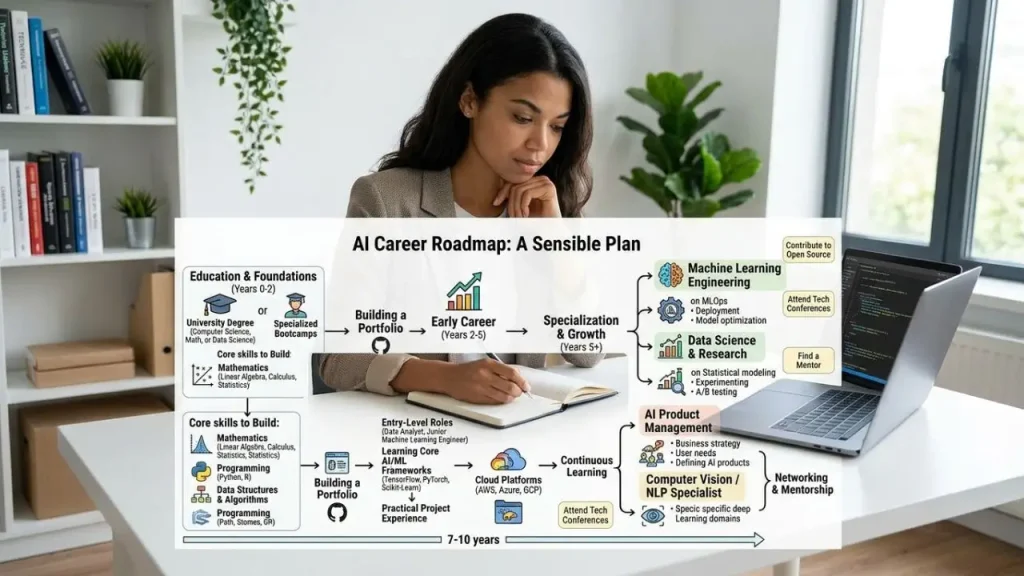
An AI career shouldn’t be planned solely based on which job happens to be popular at the moment. It makes more sense to align your interests and existing skills with market demands. Those who enjoy programming might pursue a technical path, while those who prefer working with people could focus on consulting, product management, or training.
Another key factor is a willingness to engage in continuous learning. Artificial intelligence evolves rapidly, yet there is no need to be familiar with every single new service. What matters most is understanding fundamental concepts and having the ability to explore new tools independently.
A possible path for beginners
Beginners can start by familiarizing themselves with basic AI concepts. The next step is choosing a specialization—such as software development, data analysis, writing, design, or business—followed by working on small, practical projects.
After completing a few projects, it becomes easier to identify which direction is truly appealing. If you find that you enjoy programming, you might delve deeper into Python and machine learning; if you are more interested in business processes, you could explore AI product management or consulting.
Experience Counts More Than a Perfect Start
No one is expected to master every relevant skill on day one. A realistic career path often consists of many small steps: learning a new concept, testing it in practice, and then applying it to a real-world task.
By consistently following this process, you develop an understanding over time of where AI is truly helpful and where human input remains indispensable. In the long run, this combination can be far more valuable than simply collecting certificates.
Conclusion
AI-related roles now encompass a wide range of professions. These include highly technical positions—such as machine learning engineers and AI researchers—as well as AI product managers, AI consultants, and specialists who integrate artificial intelligence into their existing fields of work.
Consequently, how you get started depends heavily on your personal interests and prior knowledge. While programming and mathematics are important for certain career paths, by no means do all AI jobs require deep technical expertise. Communication skills, domain knowledge, critical thinking, and the ability to evaluate AI outputs also play a crucial role.
If you aim to build a long-term career in this field, you should avoid focusing exclusively on a single tool. It is far more beneficial to develop foundational skills, work on practical projects, and learn how artificial intelligence can solve real-world problems. That is precisely where the most interesting career opportunities arise.
Frequently Asked Questions About AI Jobs
1. What are AI jobs?
AI jobs are roles that involve developing, deploying, monitoring, or integrating artificial intelligence into work processes. These include both technical and non-technical professions.
2. Do you need programming skills for AI jobs?
Not for every AI job. Technical positions, such as Machine Learning Engineer, often require programming skills. For roles in consulting, product management, or specific application areas, other skills may be more important.
3. Which AI jobs are suitable for beginners?
Roles such as AI Content Specialist, AI Support Specialist, AI Assistant, Junior Data Analyst, or certain positions in AI Operations can be interesting for newcomers. Specific requirements vary by company.
4. Is a university degree necessary for a career in AI?
A degree can be helpful for research and many highly technical positions. However, for numerous practical AI jobs, professional experience, self-directed learning, and demonstrable projects are also relevant.
5. Which programming language is particularly useful for AI jobs?
Python is one of the most important programming languages in the fields of artificial intelligence and machine learning. Depending on the specific role, languages such as JavaScript, SQL, or others may also be useful.
6. Can AI jobs be done from home?
Many roles in the AI sector can be performed remotely, at least in part. However, this depends on the company, the position, and specific security and work requirements.
7. What does an AI Engineer do?
An AI Engineer develops and implements AI-based applications. This can include data processing, model development, the integration of AI systems, and the improvement of existing solutions.
8. What does an AI Product Manager do?
An AI Product Manager bridges the gap between business needs and technical capabilities. They help plan AI products, define requirements, and develop suitable solutions in collaboration with technical teams.
9. Will AI jobs become more important in the future?
AI is expected to continue transforming numerous workflows. This can lead to the creation of both new specialized roles and new tasks within existing professions.
10. How can I start learning for an AI job today?
A sensible starting point is to learn fundamental AI concepts and then carry out a small practical project. Afterward, depending on your interests, you can delve deeper into programming, data analysis, AI applications, product management, or another area of specialization.
